
“There exists new music for everyone.”
An Interview with Take Notice Fund Artist Mendel Lee
• 12 minute read
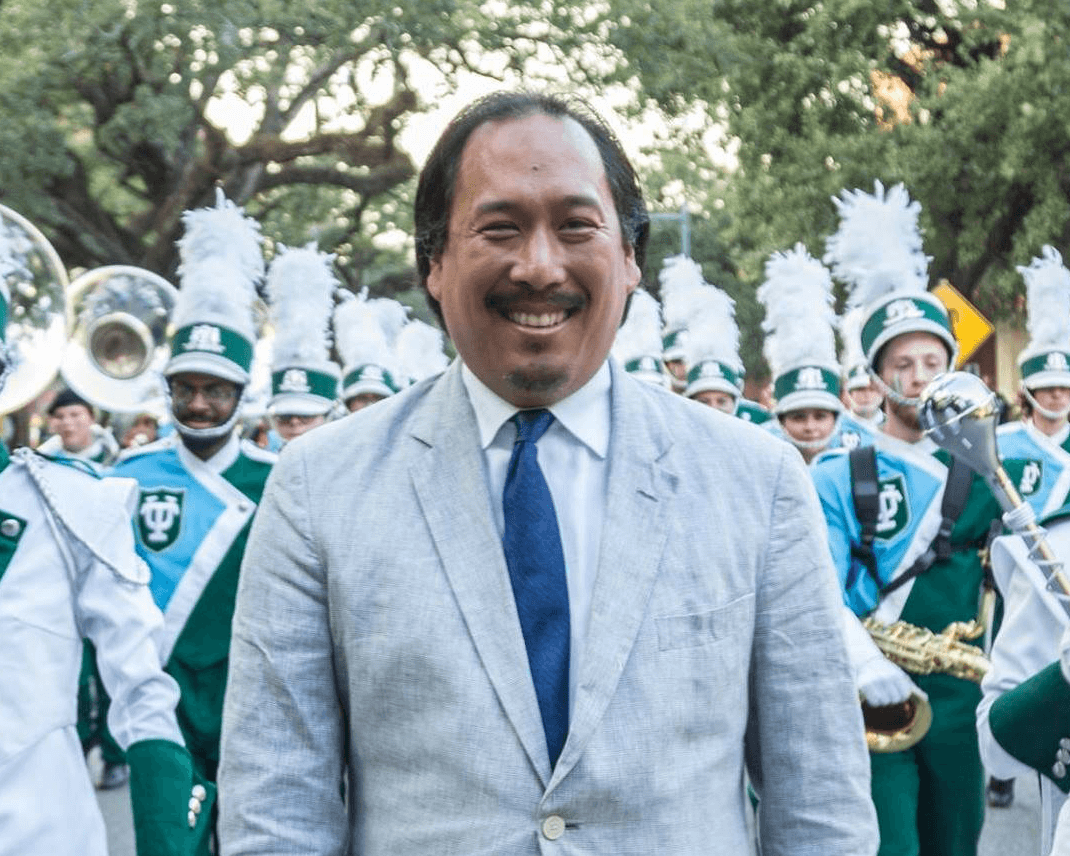
NPN’s Take Notice Fund has been supporting the creative practice and wellbeing of BIPOC artists in Louisiana since 2021. To bring more visibility to Louisiana’s artists of color, NPN asked past Take Notice Fund awardees to talk with us about their work and careers.
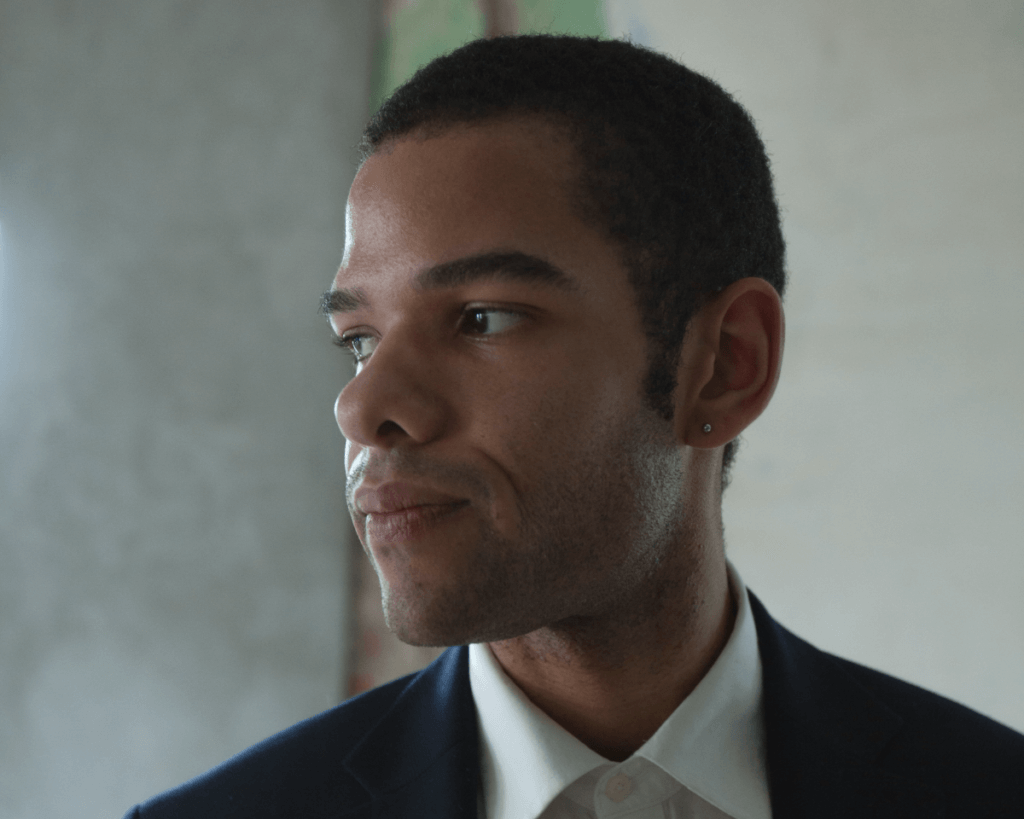
Mendel Lee, a 2022 Take Notice Fund grantee, is a composer and music educator living in New Orleans, LA, who focuses on connecting audiences with new music (from living composers). In this interview, Mendel talks about his journey from music education and drum corps to composing new music, as well as his role in promoting new music as the Executive Director of Versipel New Music.
This interview was recorded in 2024 and was updated in the summer of 2026. It has been edited for clarity and length.
NPN:
Although you’re a composer, until recently you mainly worked in music education. What led you to shift focus mid-career?

Mendel Lee:
Even though I have my degrees in composition, the majority of my career was as a music educator, specifically in the marching band realm. I decided to take the plunge to quit my collegiate band career in 2022 because I was burning out after being in music education for over two decades and I needed a change. Composition and new music advocacy was always an important part of my life even while I was an educator, so shifting my focus to that full-time felt like the right choice.
Since then, I’ve gone through a lot of discovery about my creative voice and the kind of things that I wanted to do — discovering that I had put up a lot of self-inflicted barriers, telling myself that the kind of stuff that I wanted to do was not valid and I needed to prove myself first.
So, allowing myself to create the stuff that really interests me, and to know that there are people outside of just me or my friends that appreciate and can resonate with that work, has been an important self-discovery milestone, and helped me to shed a bunch of my self-inflicted barriers to produce more quality work.
NPN:
So it sounds like your earlier work was maybe more audience-focused, and now you’ve freed yourself to explore your own interests more.
Mendel:
Yeah, that’s true. I think it’s because I’ve always had this idea that all of the varied musical styles I was interested in were in conflict with each other. My academic music, the stuff that I listen to more for fun, and the marching band world in which I wrote a lot of stuff for drum lines and for full marching bands, these are all very different stylistically, and I felt the need to siphon those in individual ways as opposed to drawing upon all of those things to create the work that I wanted to create.
I had this creed that I always gave to my students, that there are always going to be people that love you no matter what you do, and there are always going to be people that hate you no matter what you do, so you might as well be true to yourself because then the people that gravitate towards you are the ones that are gravitating towards you for being your true self.
And I think that I applied that principle well enough in my personal life, but for some reason I didn’t connect that to my creative practice. So while I still want to keep the audience in mind, I also am able to embrace the idea that all of those things that I thought I needed to separate out, I can just pull together into the true creative me.
And by doing that, then I’m allowing for the people that really resonate with that to find me in ways that I wasn’t really allowing them to find me before.
NPN:
What are you working on right now?
Mendel:
I recently finished the first movement of a new percussion sextet that has been commissioned by Mantra Percussion. The work is titled Stronger Together, and the first movement is titled Shimmers. The work is my exploration of textures that can be achieved with acoustic percussion instruments only if two or more players are involved. For the first movement, this primarily involves one player bowing individual crotale discs that are immediately choked and then struck with a mallet by another player – an acoustic representation of a regular crotale strike but played in reverse.
I’ve also started work on a new string trio for Missing Piece who are going to premiere the work in Chicago with guest violist Michael Hall and then perform it again in New Orleans with guest violist Sixto Franco this coming season. I had the opportunity to host a residency in New Orleans with Missing Piece recently, and they are wonderful human beings. We’re very excited to be collaborating together on a new work.
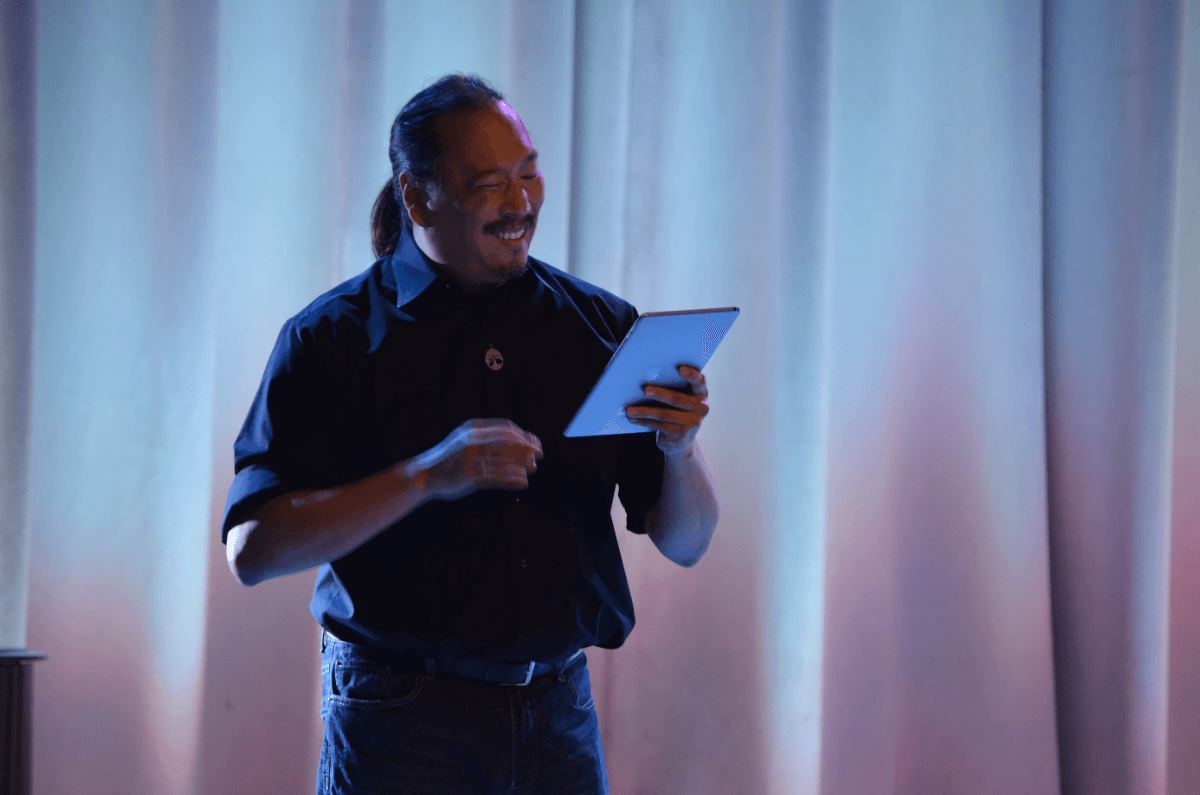
I also have in progress a four movement work for fixed audio, fixed video, and live dancers, collaborating with Jakki Kalogridis, a dancer/choreographer who is a good friend of mine. The whole project is called Through the Sonic Glass. The first movement premiered in May 2023 and is called Fast-Paced World. The second movement is in progress. I’ve done the audio. I need to do the video, and then I need to hand it to Jakki. It’s called Bee Kind.
The concept for the whole work is to take what would be dangerous sonic environments to experience in real life and put them into a virtual context so that you can experience [them] in a safe way.
So in Fast-Paced World specifically, it’s about standing or walking in the middle of the road and having a lot of fast vehicles traveling on either side of you, and allowing the Doppler effect and the various pitches to live with you standing in the middle of it, and then turning and transforming that Doppler effect into music.
The second movement is about changing the narrative of bees being pests to say, hey, bees are actually very important to our ecosystem and we need to treat them as friends.
The third movement involves freight trains. I recorded a good 10 minutes of various freight trains from a recent artist residency that runs right along a freight train route.
And then the fourth movement, I don’t really know what’s going happen yet. There’s some people that have recorded some really interesting volcano sounds, and I’m thinking about maybe doing something with that, but I’m in a space where I want to leave it open to see how the rest of the work evolves over time.
NPN:
Speaking of your audience, what do you want them to take from your work? What sort of dialogue with them do you want to have?
Mendel:
I want to be able to ignite a spark of interest and inspiration in other people.
When I was an undergraduate, I started off as a music education major, but I switched to composition because I went to a new music concert that was unlike anything that I’d ever heard before, and that exposure and discovery helped me realize that I needed new music to be central to my life. So the reason why I started a new music concert series in New Orleans is because I want to be able to replicate that level of inspiration for people that come to my concerts or listen to my work.
That for me is the most important thing. The legacy that I want to leave is to help the next generation of creators or performers that may not even be aware that that’s what they want to do, give them the avenue to just get exposed to lots of different varieties of art, whether mine or others, and find inspiration to create their own work.
NPN:
You mentioned wanting to advocate for “new music.” Can you give us a quick definition of what you mean by that?
Mendel:
I define “new music” as music written by living composers, and generally “music of our time.”
With composers from history such as Beethoven or Mozart, it’s a one-way street of the performer interpreting what’s on the page, full stop. One of the great things about new music is that it allows performers and composers to be more collaborative in putting that music out into the world. Particularly with music written specifically for the performer, the performer has a lot of agency to shape the piece the composer is writing, making it more personal and creating a bond of trust. That collaborative trust is what makes new music so special.
NPN:
In addition to inspiring audiences directly, you’ve been a big driver of expanding the new music scene across New Orleans. Can you talk a little about that?
Mendel:
So, I founded a concert series/residency series called nienteForte. I started that at the time in the New Orleans area where I felt like there wasn’t really a big new music scene. In the time since there’s actually been a lot of independent new music entities in the New Orleans area that have popped up, like Versipel New Music, The Louis Moreau Institute, and the Alluvium Ensemble.
Last year, I merged nienteForte with Versipel New Music and became Versipel’s new Executive Director. My goal was to bring more collaboration, unity, and focus to the New Orleans new music scene and to build a stronger infrastructure to our orgs that could be more streamlined.
This also includes expansion – expanding what Versipel can do for the new music community in the Gulf South, and expanding where and how we find revenue to make the organization more sustainable.
It’s been a lot of work, just wrangling a lot of energies together to try to get conversations about that and try to figure out how the different avenues really work. But it’s been also pretty rewarding to see it start to slowly come together and turn into something that I think over the next few years is really gonna pay off. And I’m pretty stoked about that.
NPN:
What drew you to music in the first place?
Mendel:
It really started with my mom, because she got her degree in piano, in Taiwan. She tried to pursue it professionally, but found that she wasn’t really great at maintaining the business side of being a pianist, so she ended up going into corporate. Even so, I had a lot of music in the house, because she was just practicing all the time.
My mom [discovered] that I had perfect pitch. I would turn around on the piano bench, and my mom would play a bunch of pitches and I would name them back, without even realizing that that wasn’t something that a lot of people could do.
My dad is not as much of a musician as my mom, [but] he used to sing a lot, especially in, like, church choirs and all that.
When I was in high school, I was in a musical theater production. And the [musical director] found out that I was passionate about being a music major and wanting to become a band director. It was really a choice between doing that versus going into computer programming, because I also have an affinity for coding.
There were some influences within my middle school and high school years, particularly in high school once I got exposed to marching band and marching percussion. Then that expanded into college, and then also the independent realms with Drum Corps and Winter Guard International. [I marched] in the Crossmen Drum and Bugle Corps for a couple of years.
I wanted to be a high school band director and teach a marching band — that was really the first pathway. Then in college I got exposed to more new music stuff as I explored composition and theory. And that’s really what led me to where I am now.
NPN:
Where do you find your community these days, and what is home for you?
Mendel:
I grew up in Eastern Pennsylvania, I went to grad school in the Pacific Northwest in Oregon, and now I live in New Orleans. And when it comes to a physical place, New Orleans has a vibrancy to it in whatever they do, whether it’s architecture or music or food or anything. That is something that both I and my partner really identify with. And so New Orleans feels like a really big home place for me.
This has become a little bit less true as I’ve gotten older, but one of the great things that I found about moving to Oregon and moving to New Orleans is that I really like going into a new situation and having to rebuild what my community is in that specific place.
I also view my community as this network of people that I’m very close to that I keep in touch with consistently. Even early on before the internet was a really big thing, I was still going on to online BBSes and just finding a lot of solace and getting to know people regardless of where they were.
NPN:
Do you feel like each of those places where you’ve lived, but New Orleans in particular, has influenced your work?
Mendel:
I can’t necessarily speak to concrete ways in which being in those regions have directly influenced my work. There’s no doubt that [they have], just through the kinds of art and music and people that I’ve been exposed to.
My music generally falls into two different categories. [The first] is taking a singular idea and stretching it for as long as possible, and seeing how much I can really milk out of that.
And then the other side, which sometimes merges with it but sometimes doesn’t, are rhythmic, complex kinds of things that carry over the bar, that are underlined by a fairly accessible or pseudo accessible groove.
And those things have definitely been influenced by [my experiences]. The marching band community in particular is very much about complex rhythms and ideas that can be made more accessible to the audience. But then also the exposure to Steve Reich and the minimalism of John Adams. Steve Reich and Bang on a Can are definitely a very East Coast influence, as opposed to some of the stuff in the Pacific Northwest, which has a little bit more Asian influence.
NPN:
Who are some artists who currently inspire you?
Mendel:
I first heard Steve Reich in eighth or ninth grade, and his music is forever at the core of who I am as a person. I love it.
Another composer I identify with is Michael Gordon. He likes to explore singular and sometimes rhythmic ideas over a long stretch of time, and that’s always been a huge [part of] my own work.
There’s a group called Animals as Leaders. It’s this trio of complex heavy metal guys that are some of the most talented musicians on the planet. They don’t have a vocalist, which is part of the reason that they’re more accessible than other heavy metal groups with a screaming vocalist. But their music is still so complex and also very challenging to execute. And they’re really fun to listen to.
Another group is Meshuggah. That group has a lead singer that screams a lot which can turn off some people. I actually really like them. Even though they’ve been around for 20 or 25 years, they somehow still manage to be avant-garde. They are trying to challenge what people may want to actually listen to, and I appreciate that.
About Mendel Lee
Mendel Lee (he/him) (b. 1975) is a New Orleans-based composer whose career oscillates between composition and artistic entrepreneurship. Since exiting his long career as Assistant Director of Tulane Bands in 2022, Mendel spearheaded the merger of his founding organization nienteForte with Versipel New Music for which he now serves as Executive Director. Under his leadership, Versipel New Music has expanded its profile as a defining force of new music in Louisiana, including the launch of Batture Contemporary, a Louisiana-focused new music festival. Mendel is also the Board Vice President of Rhythm X where he oversees committees for their alumni relations, finance, fundraising, and overall operations.
As a composer, Mendel’s music explores both the gradual evolution of singular ideas and layered syncopated rhythmic patterns over an underlying groove. His recent music also seeks to grant more equitable agency between the roles of composer, performer, and audience to create a more collaborative experience. Recognized as a VCCA Fellow and an NPN Take Notice Fund grantee, he is committed to using his creative practice and entrepreneurial spirit to show that while not all new music is for everyone, there exists new music for everyone.
Related Stories


Newsletter Sign Up
Get the latest on events, stories, opportunities, and projects from across the network.
Your personal data will be managed respectfully and responsibly, in accordance with our privacy policy.