
“The Medicine Wheel Is Always Central to My Work”
An Interview with Take Notice Fund Artist Ivan Watkins
• 14 minute read
NPN’s Take Notice Fund has been supporting the creative practice and wellbeing of BIPOC artists in Louisiana since 2021. To bring more visibility to Louisiana’s artists of color, NPN asked past Take Notice Fund awardees to talk with us about their work and careers.
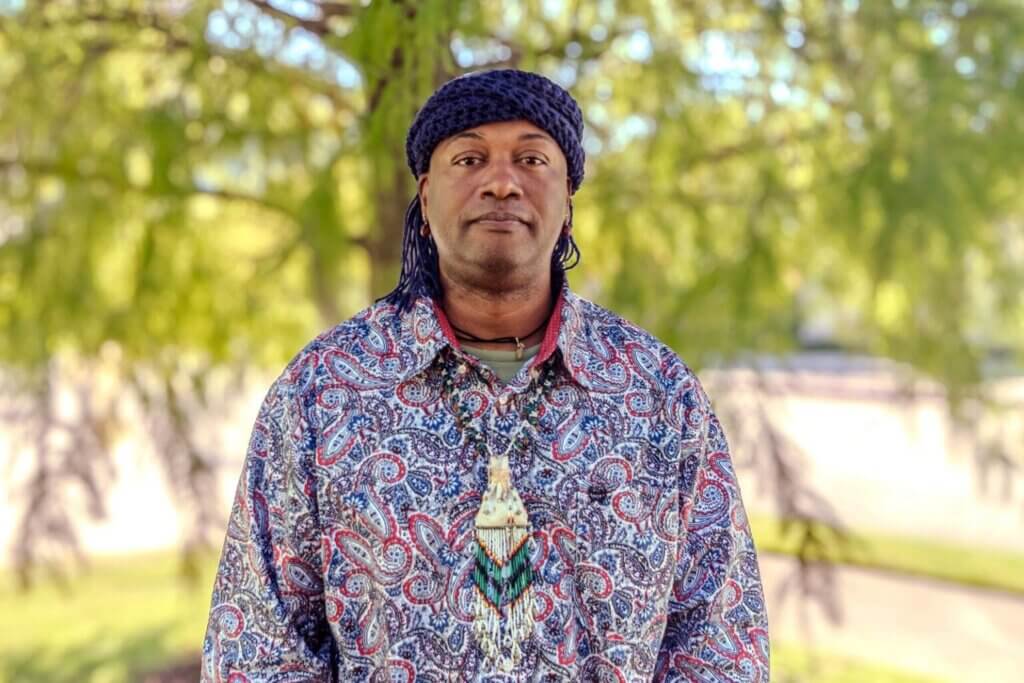
Ivan Watkins, a 2023 Take Notice Fund grantee, is an artist from New Orleans, LA, who has created murals, mosaics, and sculptures both nationally and internationally, and led more than 50 large, community-based public art projects. In this wide-ranging interview, Ivan talks about the power of color and universal symbols, his disenchantment with the mainstream art world, and his multifaceted exploration of spirituality.
This interview was recorded in 2024. In September 2025, Ivan transformed the Gentilly railroad bridge in New Orleans with his mural “The Guardians of Gentilly.”
This interview has been edited for clarity and length.
NPN:
How would you describe your work to someone who is unfamiliar with it?

Ivan Watkins:
I think of art as medicine, not just as a tool for social catharsis and political discourse, but as an actual way to heal the mind and body and spirit, in the way that religious icons or talismans work, the way mandalas work — to basically help the viewer center and align their body, their mind, and their feelings as they’re looking at the art.
My goal has always been to just try to make the world a better place in my brief life. To try to show love for all creatures, all two leggeds and four leggeds and creeping crawling and wing people, and thunder people and spiritual beings, and the ancestors and the future generations. To just try to use my talents to speak to the things that connect us.
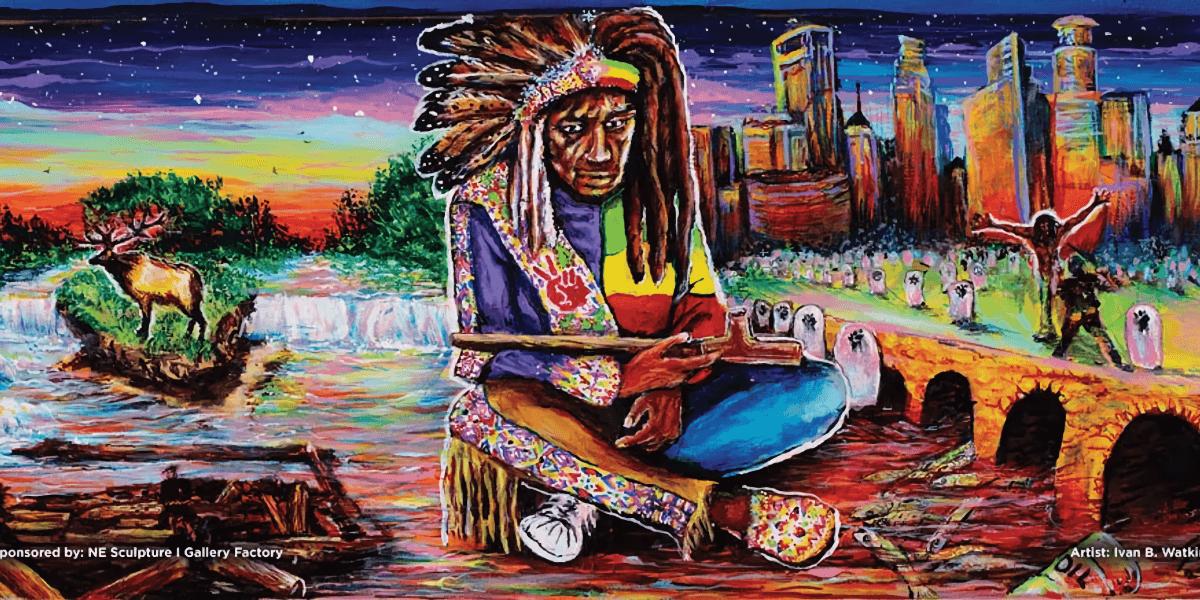
I would say aesthetically I use a lot of vibrant colors. My hope is always that if people don’t relate to my art or they don’t like the theme or the imagery, that they still walk away with a better feeling in their gut. So I try to use color in that way.
One of my mentors, Sue Ying said that as an artist, you have to make art just to remain sane in this world as a sensitive being, because we’re sensitive to the energies and the stories that are out there.
That’s what motivates me, where art is about healing. If it’s not bringing us together, if it’s not healing wounds and, and helping us to celebrate the beauty of our diversity and the beauty of our commonality at the same time, then we kind of miss it.
NPN:
I love this idea of art as medicine. How does subject matter factor in?
Ivan:
I think a lot about the power of symbols. We have so much in common, especially when you look at traditional cultures. I’ve always been motivated and inspired by that. If I look at Celtic designs, I’m seeing parallels to Coptic designs. There’s some untold link there historically, something happened there that’s starting to kind of bubble out archeologically.
When I look at the traditional garb of Bulgaria or Scandinavia, these different masks and things that the people wore, those pagan cultures of Europe are akin to Native American or Asian or African traditional cultures.
And masking, and the role that it plays in terms of understanding our relationship to nature and spirits, our ancestors – you know, what are those common threads? I mean, we all look at the same moon every day.
Ivan Watkins’ digital bio, edited by the artist.
Ivan:
So the way I approach each project is gonna vary. It might be digital, it might be drawing with pen and ink. It might be more expressive and cartoony, or it might be more naturalistic, depending on the particular project. The one universal aspect of my process is I always take a macro view. If it’s a public art project, for example, I’m gonna look at not just what’s there, but what’s the history of that community? What did it look like 500 years ago, 200 years ago, 50 years ago? What did it evolve through?
The medicine wheel is always sort of central to my work. It’s a universal symbol that’s used by the Lakota, Tibetan monks, the Yoruba, the Mayans. It’s the ring of Odin. It’s a mandala and it’s in sand paintings, Hindu art, Buddhist art. This basic circle with a cross and four colors, you always see red, yellow, black, and white, or it might switch green or blue for black or white, and it represents the same thing universally: the four winds, the four seasons, the four moments of the sun.
So for example, if I’m doing a mural, I’m gonna put the four moments of the sun in the mural. So it may start with sunrise. That’s spring, that represents east and birth and the beginning of life. And then high noon is going to be summer and youth and vigor and, you know, bright colors. They’re then going towards fall, it’ll be more sunset colors, like fall leaf colors. And then the fourth moment of the sun would be midnight, or, you know, the night sky.
So you’ll see, in some of my murals and artwork, twilight scenes, or a rainbow going from sort of red up into a night sky, like a sunset or sunrise background. And I’m just trying to convey that yeah, there’s a movement of time, but there’s also a universality that’s spiritual.
NPN:
So even though other pieces of the project are all unique and contextual, you’ve always got that connecting point. That’s really beautiful.
Ivan:
Thank you.
NPN:
What made you decide to move away from galleries and into public art at the community level?
Ivan:
I started at the School of the Art Institute at Chicago when Basquiat was still alive, and there was all this excitement about how it’s our time, urban artists. And right as that movement was emerging, in the eighties, we had this backlash of conservatism and Reaganism.
So trained artists like myself going to the School of Art Institute, going to New Orleans Center for Creative Arts, studying art history, art theory — none of that mattered in the art world. All of a sudden it was about primitive, meaning naive, art. So folk artists got their turn, the rural, untrained artists. In terms of African American art, that became the thing to buy, these folk artists who had no art training, no education, and it was exploitative.
Then graffiti artists blew up. They’re in art galleries now, they’re doing shows in Milan and Venice, in New York. They have studios around the world. And people like myself kind of got pushed to the side.
When I saw that happening, I just became disillusioned with the art world. Seeing the art economy, seeing how it is racist and classist. That wasn’t the energy that I saw around the gallery scene when I first went into the art world as a student.
So we went about creating a lot of our own alternative shows and spaces. I was on the board of a not-for-profit where I would curate and create shows that would put stuff out there, but not through the mainstream galleries.
And that led me to public art. Basically, I look at Diego Rivera, Siqueiros, Orozco, Clemente — the Mexican masters, as they’re called — I looked at their idea of a new economy for art? How do I make art that’s relevant to the people, that engages with allegory, with that history, that primitivism, that tribalism? The stories that aren’t told?
NPN:
It sounds like you’re looking for those intersections where we’re more alike than different, and then having those conversations through public art where it can reach the people who aren’t in the ivory tower. It’s not just one-off or decorative, it’s got depth and allegory and meaning.
Ivan:
Yeah. It’s community-based public art, where it relates to the history of that particular city or environment. I’m not putting a cube in the middle of a park, you know?
I’ve done things around the country and internationally, working with populations, with participants of all ages, always figuring out ways to have them contribute to the design process so they’re not just manifesting my artistic vision. They’re part of the actual design. Their ideas and their hand in the work is visible.
So, you know, really shifting in terms of making art that’s visible and available to people who aren’t going to galleries or museums, but who also need art, in some ways even more so.
NPN:
Looking back, what do you think awakened in you this interest in making connections through art? Where did this all start?
Ivan:
Home. My mother was a Golden Apple teacher who worked in primary education. My father was more of a self-taught man, even though his family was very well educated. My grandfather had a Persian rug cleaning business, so he understood Persian rugs and designs. He spent time in Japan in the Air Force, and he had traveled. So even though he adopted this sort of Cajun “We gonna go scoop the crab nets to get dinner” aspect of the local culture, he still had this global outlook. And, you know, growing up on jazz and blues. All of that inspired me.
Riding out to the country to visit our grandparents or cousins always made me reflect on our connection to the past. That sense of connecting with spirit — my great grandmother in the Baptist church, how spiritual my own family was, the visions that I had spiritually as a child. All of those things aligned in terms of my sensitivity and desire to want to capture and express this somehow.
We had I Want to Know books and the Encyclopedia Britannica, so I would put myself to sleep every night just flipping through and looking at animals, at the textures and colors of birds and animal hides. My dad collected National Geographics, so looking at these different cultures around the world always struck a chord in me.
Initially, I wanted to be a writer and filmmaker. My mother was a self-taught filmmaker with Super 8 film. To me, there is no more powerful medium than film. And I still aspire to be a filmmaker more than anything. I went to art school specifically to make these Ralph Bakshi-esque grown up animated movies, like the stuff I grew up on in the seventies.
And Kung fu movies really inspired me, Bruce Lee and Shaw Brothers. At the library I would look up “Shaolin,” and that led me to Lao-Tse and Taoism. So at like nine, ten years old, I’m studying Taoist poetry.
NPN
That’s a big leap, from Kung fu to Taoism!
Ivan:
Looking at Lao Tse’s Taoist poetry and all this stuff, I thought, “Wait, this guy’s words sound a lot like what I’m learning in Catholic school about Jesus’ teachings and the Gospels in the Bible, but he was writing before the time of Christ… Wow!”
So I always had this kind of macro view, and it wasn’t until people were like, “Oh man, you can really draw, you should be an artist,” that I moved more towards visual art.
But for me it was all the same. Research, story, allegory, documentary film, feature film, animated film, comic book — they were all extensions of the same thing for me. There’s so many stories that haven’t been told.
Going to the New Orleans Museum of Art was something that my mother made us do on a regular basis, I grew up looking at those Dutch masters paintings, and still lives and stuff.
And along with looking at that, I ran into this guy while painting a mural at A.L. Davis Park, he called himself “Uncle Tom, Tom the Painter.” He painted the original Brown Derby, though the building’s now gone. But it was an old saloon, bar room club that goes back to like, when my parents were children. And he had this mural on the side of the building. It was just a brown derby hat, monochromatic with brown lettering and a horse. And I just remember looking at that wall and thinking, “You know what? I can do that.” Because I could see how he did it. Every time we’d pass it, I’d study it and I’d be like, “I can do that. I could make money doing that.”
NPN
That’s interesting. Seeing public art helped shape your interest in art, and now you’re making public art in communities where it has the opportunity to inspire or spark conversations for people who may not go to museums, or who feel intimidated by “art.”
Ivan:
When you say intimidated, that hits right on something I was thinking about earlier, which is that it’s really all about breaking down barriers and hierarchies.
So if we look at all of it, whether it’s tribal symbols, or dreamtime art from Australian aborigines, or cosmology, or digital renderings and AI art — we’re just trying to measure nature. We’re trying to look at and represent nature.
And I think that outlook speaks to what I’m often trying to convey, particularly to young students. You know, “Don’t be intimidated by this vocabulary. It’s just another person trying to understand. We’re all just trying to measure and understand what’s out there, what happened before, what’s coming next.
NPN
We’re always taking in information, trying to process it, and put it back out there in different ways. That makes a lot of sense.
One more question. When you think about your community, your home, what does that mean to you? And how has that influenced your work?
Ivan:
I was privileged to have an opportunity to meet an artist from Mozambique named Malangatana Ngwenya as a guest artist at the School of the Art Institute. And he said the same thing that my Uncle Willard Fool Bull, who helped bring me into the Lakota traditional ways, said. I’ve heard Bob Marley say the same thing in a documentary.
Malangatana said, “My home is in my head. My home is wherever I go, that’s my home.” And when he said that, all of a sudden things started moving in the room and shifting, because it’s like all his ancestors were there with him.
To me, the sense of home is about that. It’s about where you feel you belong. And if you’re a spiritual person attuned to nature, you can go anywhere and the spirits of that land will recognize and acknowledge you. As I notice, birds will acknowledge me and circle me, kite hawks will follow me. And that reminds me of growing up and walking the levee by my house, and the energy of helping my dad pull weeds in the garden. And all of that’s home.
But if you want to talk about community, I would say my community goes back to my ancestry. It goes back to what’s in my heart. It goes back to the medicine wheel, where the physical plane meets the spiritual plane.
My ancestry is multicultural. I’m indigenous, but I’m also, by genealogy and ancestry, European, and of course African. When I was growing up in New Orleans, I wasn’t considered Creole. I’m not Creole, but I’m still Creole. And is Creole a culture? Is it a race?
It made sense to me, if I wanted to grow spiritually, to go to those people who could help me understand things I wasn’t learning in the church or from my family. And I was blessed. I ended up meeting the grass root carriers of the traditional culture.
My Grandma out on the res was the closest living relation to Crazy Horse, And the Fool Bulls — the Lakota family that adopted me — founded the Native American Church in the state of South Dakota, and their ancestors rode against Custer. The Lakota people taught me that we’re all related.
And so again, that’s that medicine wheel, right? That’s what I draw from. That’s where I live, where all colors of people are related.
So how do I express that in the local community I grew up in? I was always motivated by the call of Mardi Gras Indians or Black Masking Indians of Carnival.

And so I did research into that, looking at what were actual Black Indians. And that’s a story. There are Indigenous Black people who have been written out of anthropology. There is an actual conspiracy to disguise that people’s birth certificates were changed – “No, you’re Black, because you look too Black to be Indigenous.”
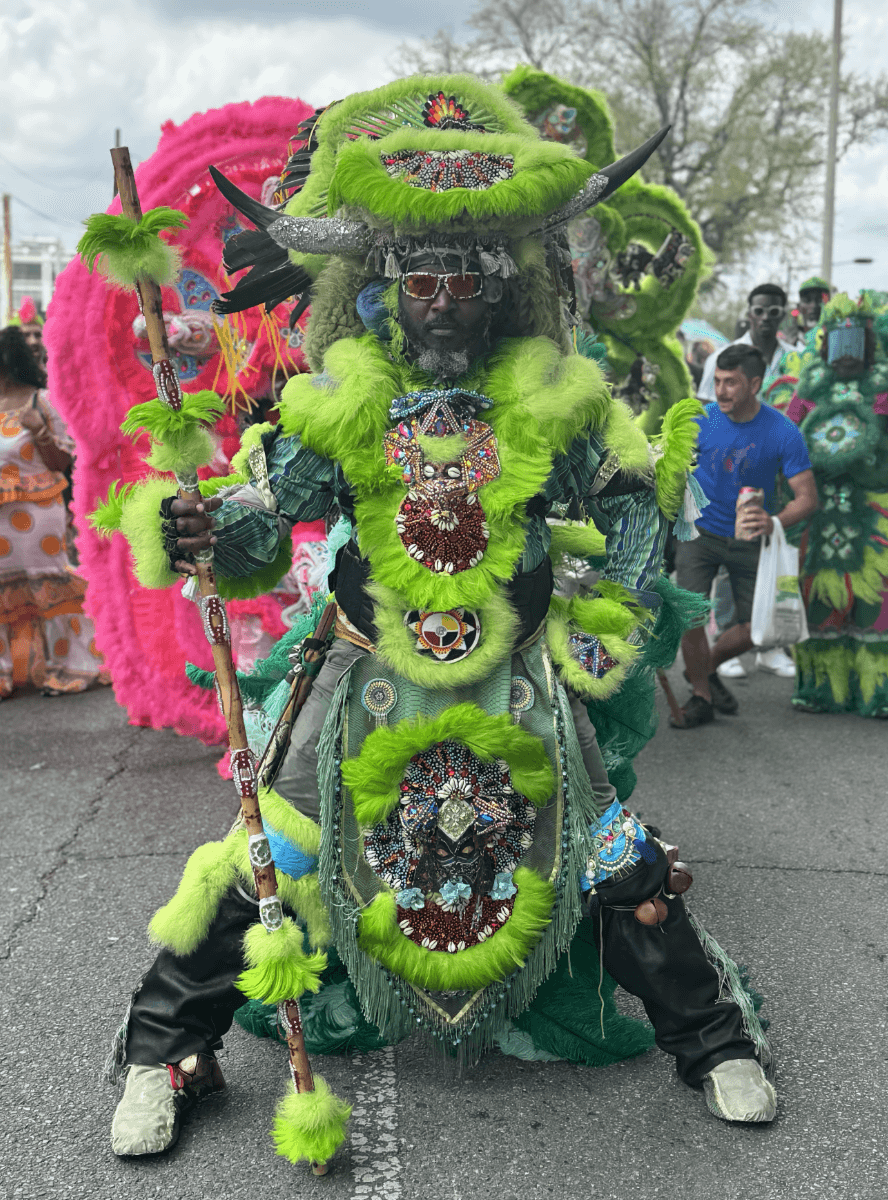
So that motivated me on another level to document, but I’m out there with my camera and I’m seeing more cameras than feathers. So let me put the feathers on.
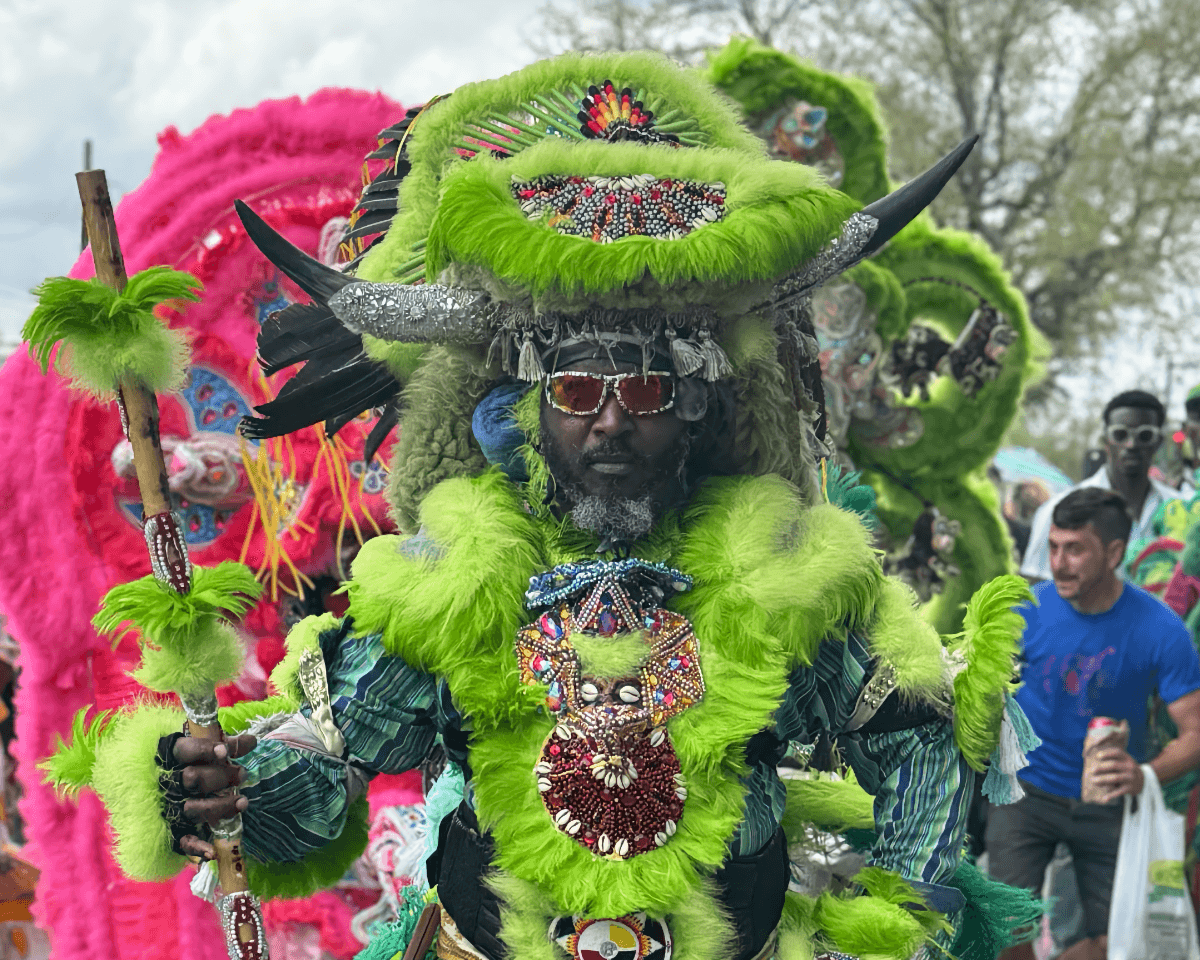
And so I began masking and sewing, and I participated in the Black Masking tradition, but I bring all of that Lakota spirituality and experience into it also. I’m out there with eagle feathers my family sent me to use for my suit.
NPN
That’s interesting to be able to walk through the world and into those different situations and say, “Hi, I’m bringing a lot more to this than you may perceive. I come from all of these different worlds and I’m able to speak the language in all of them, but I am myself outside of them.”
Ivan:
Really, I’ve always seen myself as the scout. You know, I’m gonna go up to the mountaintop and look out, then come back and try to tell the village what I saw.
About Ivan Watkins
Ivan Watkins is an internationally recognized fine and public artist/muralist, ethnohistorian, lecturer, filmmaker, and arts educator, administrator, and curator. He was born and raised in New Orleans, where he graduated from Brother Martin H.S. and NOCCA (New Orleans Center for Creative Arts). He holds a BFA from the School of the Art Institute of Chicago (1990) and a master’s degree in Social Science from the University of Chicago (2003), and he was a PhD (ABD) Candidate in Anthropology & History in Urban Studies at the University of New Orleans.
Ivan is guided by a strong commitment to fostering social catharsis through art, via both public engagement, with over 50 community-based murals, mosaics, and sculptures throughout the United States and abroad since 1989; and public education, through workshops, lectures, residencies, and curriculum and program development.
He created and managed the Arts Partners in Residence program for the Chicago Park District; led urban anthropology interns for the Center for Cultural Understanding and Change (CCUC) of the Chicago Field Museum; and has served as a Professor of Art History, Sociology, and Community Engagement at Northeastern Illinois University, the School of the Art Institute of Chicago, and Dillard University. In addition, he has been a Guest Lecturer of Anthropology and Black Indian History at the American Anthropology Association Conference, Midwest Anthropology Conference, University of Chicago, University of Michigan, UCLA, Tarrant County Community College, Elkins College and West Virginia University, Tom Dent Lecture Series for the Jazz & Heritage Foundation’s Congo Square Festival, and Black X Red = Maroon Festival at Ashe’ Cultural Arts Center.
Ivan’s documentary projects include ZAMBO, which focuses on African and Native American cultural survival; The Blackheart Man, which explores the theme of self-sacrifice in folk heroes and leaders; and Success in the Making, a biographical portrait of TRU Records visual artist Kernell Reynolds and the emergence of Gangsta Rap entrepreneurship.
He is known in the world of martial arts as a treinel (teacher) of Capoeira Angola. He has taught Capoeira at schools and workshops around the country and abroad, including at the Dance Center of Columbia College. His research on Black Indians, Maroons and Capoeira led him to receive funding from the Palmares Foundation in Brazil, where he has conducted research, screenings, lectures and mural workshops.
Ivan is an integral part of the New Orleans Black Indian Masking tradition, He masked with the Northside Skull & Bone Gang, then became the “WildMan” of the Golden Feather Hunters, formerly of the Yellow Pocahontas Tribe, of New Orleans Black Indians.
Learn more at blacfoundation.org/ivan-b-watkins.
Related Stories
Newsletter Sign Up
Get the latest on events, stories, opportunities, and projects from across the network.
Your personal data will be managed respectfully and responsibly, in accordance with our privacy policy.