
Where Are You in This Story?
Hali Dardar on Land Acknowledgments & Colonial Shout-Outs
• 7 minute read

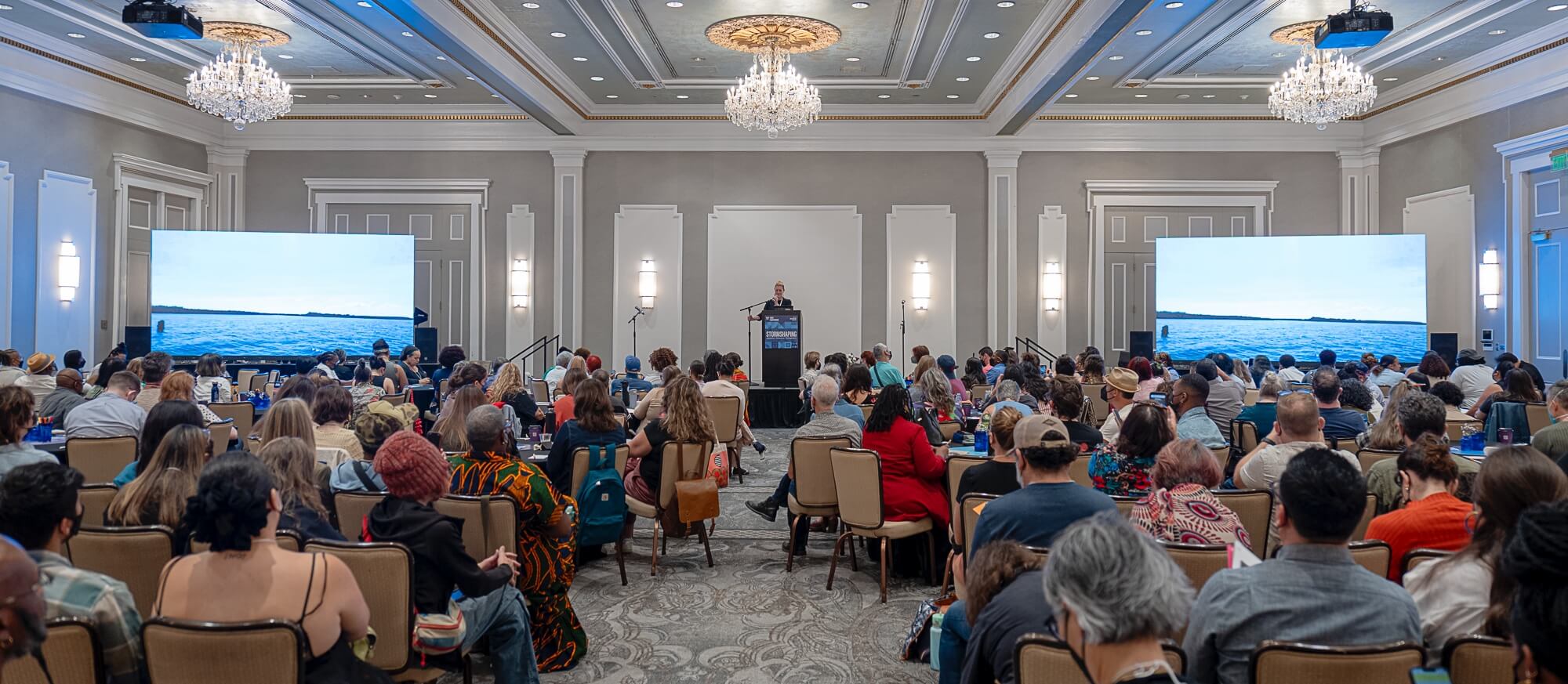
During the opening assembly of NPN’s 2025 conference in New Orleans, United Houma Nation artist Hali Dardar and members of Bvlbancha Public Access premiered their Colonial Shout-Out, a video and accompanying research text capturing the process of dispossession and displacement in Bvlbancha.
NPN’s Southern Programs associate, Daniel Pruksarnukul, sat down with Hali Dardar to discuss land acknowledgement practices, the intentions of the Colonial Shout-Out, and how other communities can take on this methodology.
Bvlbancha — the Choctaw name for the area colonially known as New Orleans — means “place of many tongues,” reflecting its significance as a place of cultural confluence. When the City launched its “New Orleans 300” tricentennial campaign in 2018, Indigenous community members countered with “Bvlbancha 3000,” challenging the City’s erasure and acknowledging the past, present, and future of Indigenous peoples in Southeast Louisiana. Land acknowledgements came into more common practice around this same time, and Indigenous community members in a heavily touristed conference city like New Orleans are frequently asked to lead these practices. Hali Dardar reflects on these asks in her conversation with Daniel Pruksarnukul:
“Everything should start or come from a perspective of relationality,” Hali says. “By inviting someone into your conference, you are beginning a relationship with the Indigenous community of that area, and that relationship — whether it’s between Indigenous and non-Indigenous organizations or a conference organizer and an Indigenous person — is incredibly important.
“Land acknowledgements have done a massive part to get rid of erasure. For a conference, when you do land acknowledgements you’re creating a place where Indigenous culture is able to be visible within your field. And then it also connects the Indigenous attendees from your field to the local Indigenous people here.”
Hali also shares some of the common pitfalls of the practice. “Land acknowledgments usually happen in the introduction time, when an Indigenous person comes up and says, ‘Hey, we’re here.’…. ‘We used to be here’ is the worst way to put it. ‘We used to be here and somehow I’m still standing here today. And thanks for just saying that we still exist.’”
“Everything should start or come from a perspective of relationality,” Hali says.
The brief intro format often forces Indigenous people to choose between important layers of context, she notes. “You’re asking this person to come up on stage in front of a bunch of professionals and give a succinct version of the history of the trauma of their community, geographic references of locations and citations of what happened, and then also a cute little advertisement plug of ways people could do better. That’s a chaotic triumvirate to ask someone to do in five minutes.”
A colonial shout-out starts by focusing on the part that’s evergreen — the history — by offering “a succinct rundown of the process of dispossession over land.” Hali first encountered the idea for a colonial shout-out from Adriel Luis, a curator at the Smithsonian’s Asian Pacific American Center, who was doing a project in New Orleans in 2019.
Bvlbancha Public Access’s (BPA) Colonial Shout-Out is not just a story of local history, it’s a reflection of local aesthetics as well. As Hali explains it, “New Orleans is a jazz city — some things are planned and some are spontaneous. So we wanted to create something people can spontaneously riff with.” The written document of the Colonial Shout-Out is “a starting place for your own jazz score,” with eight pages of history and nearly 100 footnotes. BPA also created a condensed, seven-minute video version, filled with images, historical citations, and humor. “We are showing the receipts, and it’s very tongue-in-cheek!”
The humor in the text surprised NPN’s audience when Hali and BPA first shared it at the October 2025 conference. “It’s such a beautiful and effective way to approach this,” Daniel says, “because it’s irreverent, it’s funny, while the story itself is so deep. If the tone was solemn, the audience might feel like ‘I can’t handle this,’ or ‘I can’t receive what you’re saying to me.’”
“It’s a hard history to talk about,” Hali says. “There’s a lot of pain in that but also a lot of responsibility. And for me, those are housed in the same body. I need to acknowledge that pain, how it impacted entire communities, including my own, and how it has formed me into what I am. I also need to acknowledge that the benefit of this colonial process has also formed who I am. How do I hold that together as a person, and what do I move forward that is as honest as possible to all those realities?” Much of Hali’s voiceover in the short video is flat. “That’s where I needed to be in order to talk about some of these things. It’s almost emotionally disconnected at points. It’s important for storytellers to embody these things at times, but it’s also important to let them be, as existing. You have to get out of the perspective of yourself in order to look at things more clearly sometimes.”
“In acknowledging the labor and the heavy weight of doing this work,” Daniel says, “the audience has accountability by receiving this. The end of the Colonial Shout-Out leads towards ways in which a community of people living on this land can be in right action.”
“What I want the Colonial Shout-Out to do in its best moments,” Hali says, “is plot the track of what has been happening, to show the patterns and the systems. I think if we’re very transparent with that, the audience should have an idea of who they are and where their positions are in each of those systems. And then it’s an opening — this type of transparent knowledge is an opening for course correction.”
For audiences, receiving the piece in the context of an event is an important first step. “Sometimes just sitting with it and listening to the whole thing — being open and present and deeply listening to the seven minutes, in a world where most things happen for 30 seconds — is already a course correction.”

Going further, “We hope people will think deeply on the question, ‘Where are you in this?’ Not just where parts of you are, but where the whole of you exists or resides within this story and pattern. And then, ‘Where do you want to be in this story, and what type of future do you want to see?’”
BPA’s Colonial Shout-Out is freely available to the public to be used, shared, and inspired by. And while it’s “very specific to the land we’re on right now,” Daniel tells Hali, “you’ve provided an amazing framework for a process that should be done everywhere. Is this the type of work you’re passionate about?”
“Absolutely,” Hali responds. “I appreciate understanding the shout-out from Adriel, and I hope other people take it on too. I’d love to be a part of these processes with others. The Colonial Shout-Out is a great tool, and I’m really grateful that I was able to make an attempt at it.”
Daniel was driving his kids to school one day, listening to the Colonial Shout-Out, and his 8-year-old heard something that made him peek his head up from his book and say “I know that!” Daniel observes that “he is starting to piece together things he’s hearing and learning as it relates to how he’s living here, which I think is really cool. An 8-year-old can be informed, and can start this process.”
“In the best of worlds, this is what history class would be,” Hali says. “Curriculum-based stories happen in this kind of fictional, abstract context of what ‘Louisiana’ is. It was so different from the lived experiences we have at home. Like your son who said, ‘Hey, what you’re listening to — even though it’s in a higher polished context — is something that relates to me,’ this is incredibly rare a lot of times for a lot of people. The shout-out is meant to shatter that isolation and bring an individual’s story into something that’s more collective, to shatter those barriers between lived experience and what we talk about in a collective space.”
About Hali Dardar
Hali Dardar is an enrolled tribal member in the United Houma Nation. She is an artist in the Bvlbancha area of South Louisiana, operating within the gradient of multi-media artist to business administration — including live stream production, community cultivation, archive design, and memory studies. Hali is the co-founder of the Houma Language Project and Bvlbancha Public Access. Her current work happens with Art Transit Authority; and past work includes Smithsonian Language Vitality Initiatives, Shift Collective, and Louisiana Endowment for the Humanities.
Hali received an NPN Southern Artists for Social Change award in 2020. Bvlbancha Public Access — an NPN fiscally-sponsored project — began in 2021 as an outgrowth of that award. BPA collects stories, facilitates art, and produces events on Indigenous identity in the Gulf South.
If you’re interested in learning more about the Colonial Shout-Out practice and how to develop one in your community, please visit Bvlbancha Public Access.
Related Stories


Newsletter Sign Up
Get the latest on events, stories, opportunities, and projects from across the network.
Your personal data will be managed respectfully and responsibly, in accordance with our privacy policy.