Why Culture Matters to Justice
Chicano Cultural Resistance, a Case Study Across Generations
n/a
By Tanya Mote
• 20 minute read
Why Culture Matters to Justice is a series of essays commissioned by NPN’s Culture Justice Initiative (CJI) and designed to grow our understanding of culture as a force for transformation.

Denver has ranked among the top seven most gentrified cities in the country every decade since the 1970s. During the pandemic, it was one of the fastest gentrifying cities in the country, second only to San Francisco. Surging eviction rates in 2024 forced thousands of people out of affordable housing and the record pace continues in 2025. Tenant representation is historically low.
In 2026, Denver is becoming a place where only elites can afford to live. With the new Burnham Yards redevelopment, the Westside is increasingly in peril.
Making Place
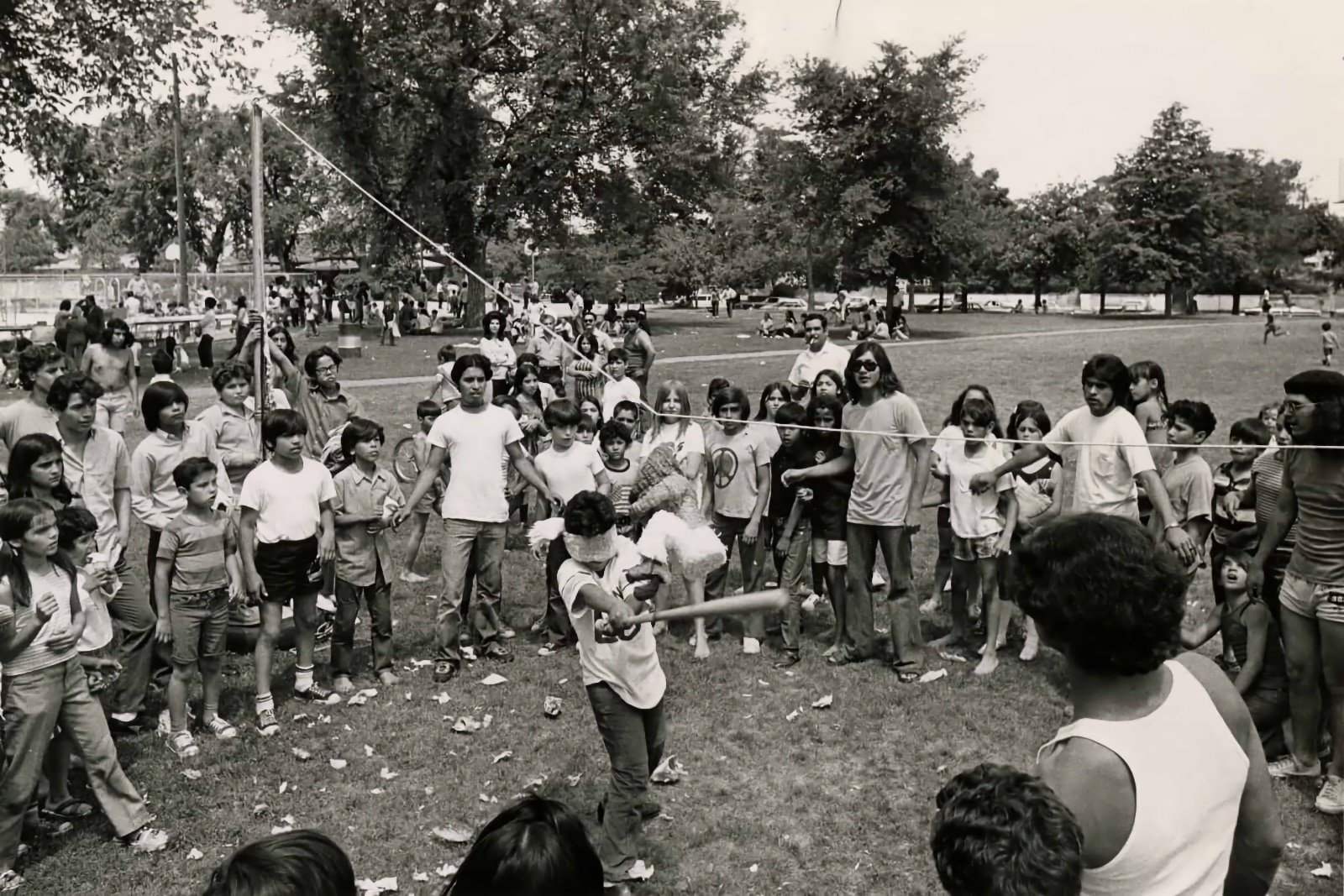
The opening notes of “Cherry Pink and Apple Blossom White” drift from the balcony. Tension rises against a steady pulse. There are no muted trumpets, no horns at all. Only an organ, played by a nun. At St. Cajetan’s Church in Denver’s Westside, teenage girls learn to mambo. Families attend services, weddings, and funerals. The church is at the center of the community; it is a mutualista, a site for civic engagement and organizing, a place where teenagers come to hang out. Descendants of grandparents and parents who fled from Mexico during the revolution joined descendants of the Pueblo Revolt to carve out spaces to live free.
This is Denver in 1955. 9th Streeters, Westsiders, residents of a neighborhood later called Auraria face violent segregation, wage theft, and discrimination. But at home they cultivate sanctuary. They tend to their gardens, listen to boleros, and play music with friends.
Police target residents, but they still walk with a swagger.
II. From Forced Migration to Found Home
Revolution exploded in Mexico in 1910. Land dispossession, brutality, and political exclusion bludgeoned peasants, middle class professionals, and urban workers alike. Only elites prospered: landowners, industrialists and foreign investors, brazenly enriching themselves under the guise of economic expansion designed to benefit everyone.
From 1910-1920, factionalized and retaliatory chaos and instability reigned in Mexico, and more than one million people fled the instability, poverty, and violence caused by war at home.
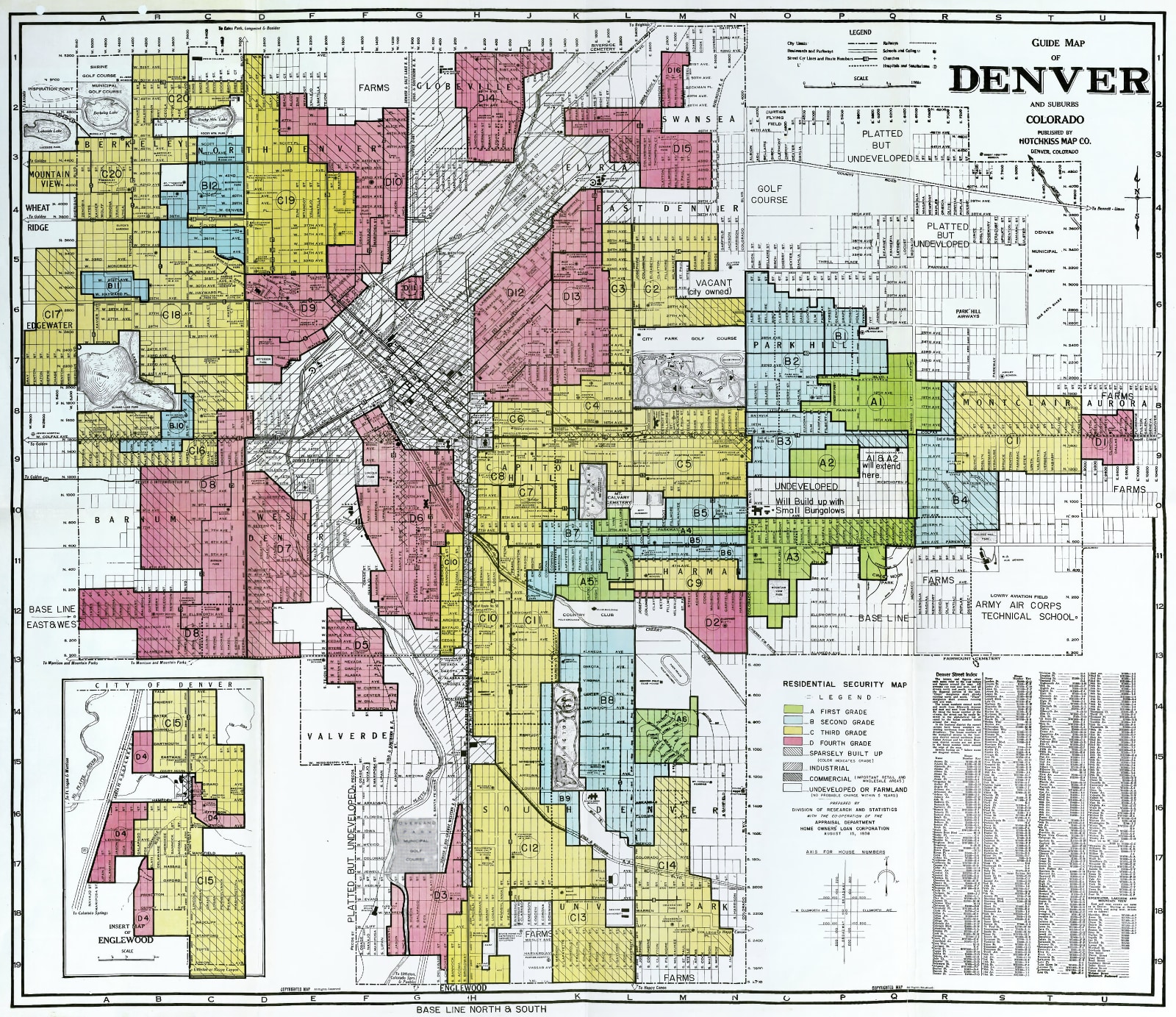
They came on trains. They came on foot or on horseback. They worked in the beet fields, the railyards, and the smelters. They worked as laundresses and cooks. They worked in warehouses and factories. They came to the Westside seeking permanence. They followed relatives, refugees who came before them to this neighborhood on 9th Street, seeking safety and community. But they were hemmed in, corralled into neighborhoods scorned by the gentry. Restrictive covenants keep them from moving into white neighborhoods. Home Owners’ Loan Corporation (HOLC) maps used to redline Denver in 1938 grade large Westside areas “hazardous.” Mexican immigrants were blocked from opportunity and upward mobility. Systemic disinvestment and calculated, systematic marginalization prevented them from reinvesting in their homes, one of their only sources of generational wealth. The lawns were manicured, and the houses have fresh paint, but politicians referred to their oasis as a slum, dilapidated, and derelict.
The Westside, north of La Alma, where the children of many revolutions live, is called Auraria by developers. In 1956, the zoning in Auraria is changed to prohibit new residential construction and to suppress neighborhood reinvestment. In 1965, the South Platte River floods, and it devastates railyards, roads, and neighborhoods. Auraria is written off. It is blighted. Denver politicians pursue clearance. By 1969 voters approve financing for an urban higher education campus. More than 300 households, over 1,000 residents, and 181 businesses are displaced.

Home Is Where the Harm Is
The cops shoot Louie Pineda in the back.
It happens in the early morning hours of July 12, 1967. Police respond to a report of car prowling at 1450 Mariposa St. The cops claim to shoot Louie in the chest, but the autopsy shows the bullet enters the body through the boy’s back.
Louis Timothy Pineda is dead at seventeen.
Westsiders hang “Justice for Louie” signs in their windows and protest in the streets. In the fall, a judge rules the police-shooting as self-defense.
It is 1967, and civil rights protests in the deep south extend to cities like Newark, Detroit. and Chicago. Farm workers organizing alongside Cesar Chavez launch a national grape boycott. Land Rights activist Reies Lopez Tijerina seizes the courthouse at Tierra Amarilla, New Mexico.
Hundreds of thousands of people march to protest the escalating war in Viet Nam.
In the fall, Che Guevara is captured and executed, but intensified liberation movements continued to erupt all over the Global South.
Local movement actions gain traction.
In 1968, a women-led strike against the Kitayama floral plant in Brighton, Colorado brings labor and student organizers together; the strike galvanizes the movement and builds momentum.
In 1968, Denver Eastsider Corky Gonzales, a former boxer and Democratic politician, creates the Crusade for Justice, a multi-issue Chicano civil rights, cultural, and educational organization. Gonzales becomes a leader in the national Chicano Civil Right Movement and the Crusade becomes an active force in Colorado movement politics.
In Denver’s Westside (e.g., Auraria and the neighborhoods south of West Colfax, La Alma, and Lincoln Park), discontent grows. Neighbors are weary of police violence, housing discrimination, school segregation, and political exclusion.
The racist circumstances that Westsiders face force them into tight-knit and collaborative units. Like all communities of color, they utilize reciprocity and solidarity not only to survive but to advance their communities. In response to marginalization, they create their own infrastructure and community institutions.
Finding Our Way
The Mexican American generation, the first generation born in the United States, is eager to participate in public life, and the civic institutions they create reflect their commitment to advancing civil rights.
They belong to League of United Latin American Citizens (LULAC) and the American GI Forum. Families who migrate to Denver from southern Colorado and Northern New Mexico belong to La Sociedad Protección Mutua de Trabajadores Unidos (SPMDTU).
Churches like St. Cajetan’s become sites for progressive organizing especially after Vatican II. Liberation theology resonates for Westsiders and the mandate informs labor organizing, activism against police brutality, and resistance to displacement.
White flight in the 1950s creates an opportunity for progressive churches to fill space formerly occupied by conservative white churches who follow their parishioners to the suburbs. The Denver Inner City Parish founded by Mennonites in 1962 becomes a neighborhood hub, a site for organizing, a sanctuary for activists, and an engine for progressive, community-based programs.
Westsiders leverage an influx of resources from the War on Poverty programs to transform the Auraria Community Center and to sprout myriad community organizing projects, including the Westside Improvement Association, which in turn informs the Westside Coalition and the Westside Action Program.
Before the movement boils over, Westsiders are already passionately resisting displacement in Auraria, circulating petitions and testifying at city council meetings. They boycott grapes and picket grocery stores. Westside students increasingly challenge school discrimination and begin staging small protests and sit ins at West High School and feeder schools.
They organize to oppose the egregious police harassment and constant brutality, only punctuated by the death of Louie Pineda. The Chicano Movement does not make Westsiders into political animals. They have always been resilient, resourceful and keen to engage. When circumstances converge and the movement ignites, they have already built a durable edifice to support it.
Humans have always been willing to fight not just for survival but for places, communities, rituals and ways of life. In response to marginalization, Westsiders built a community. The neighborhood surrounding St. Cajetan’s church was the largest Spanish speaking enclave in the city. Westsiders were unwilling to let social arrangements that sustained them to be destroyed. The Chicano Movement added dimension to an existing concern for culture. It named culture, the reclaiming of narratives, and authentic knowledge of lineages as a source of power. The Chicano Movement was propelled forward by a rediscovery of roots, language, and cultural heritage and defined by artistic expression. Chicanos would no longer accept the narratives thrust upon them. They would not only reclaim their history and assert their right to know and practice their culture, but they would also demand that others respect them, acknowledge their rights, and accept them as equals on their own terms.
Poetry as Catalyst
Students at West High School long to read the works of Chicano poets and to learn how their ancestors invented the concept of zero centuries before it appeared in Europe. Instead, their teachers deride their intellect with racist assumptions, and counselors track them into low paying service jobs or military service with guaranteed deployment to Viet Nam.
In conversations with their parents, they learn about the places in Mexico where their families lived and begin to study the region’s dances. They study the mural traditions of Mexico. But when they go to school, they are punished for speaking Spanish. They receive detention for criticizing courses that do not acknowledge that their own histories and cultures exist.
The actions of their teachers are punitive, and the environment is harsh. Increasingly, they are unwilling to accept it.
Hundreds of students walk out of their classes at West High School on 20-21 March 1969. They rally outside the school and then march through the neighborhood. Mounted officers and riot squads clash with youth in the streets. They drag students by their hair, kick them in the ribs and beat them with batons.
Demonstrations spread. Hundreds of Chicano students from other Denver schools join. Community members, including parents and local activists, join in solidarity, turning the walkouts into a neighborhood-wide protest.
The West High School Blowouts become one of the most important Chicano youth-led protests in Colorado history. They are followed two weeks later by the First National Chicano Youth Liberation Conference, hosted by the Crusade for Justice. Thousands of young people travel from California, Texas, New Mexico, Colorado, Arizona, and the Midwest. At the conference, the students draft El Plan Espiritual de Aztlan, the movement’s manifesto.
The Westside is on fire. The revolution has begun.
How a Theatre Anchors a Neighborhood
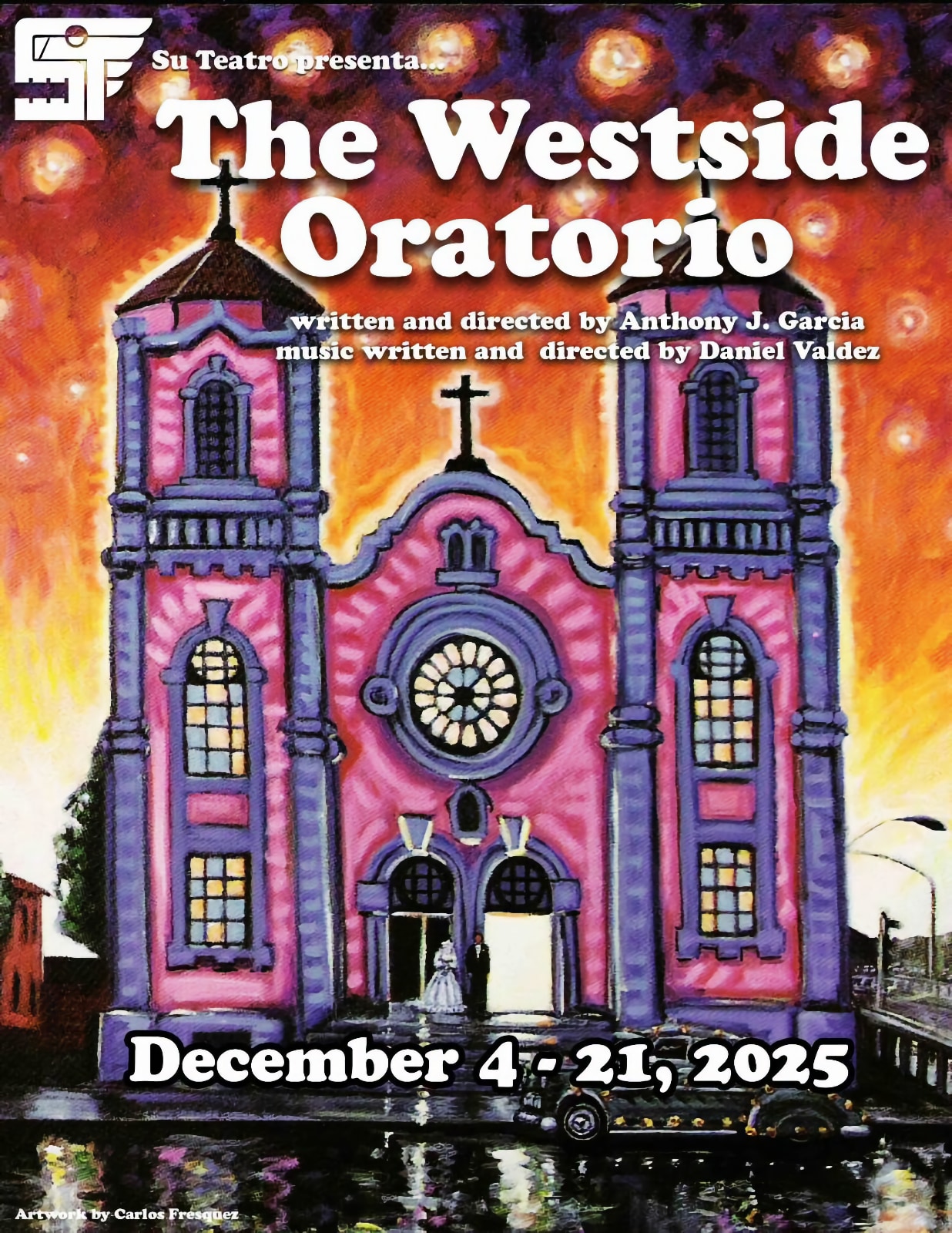
In 2003, a small throng of community activists and Su Teatro supporters protested the takeover of the Denver Civic Theatre at 721 Santa Fe Dr., in Denver’s Westside by Sibling Entertainment, a New York City company. The group intended to “take over” the Denver Civic Theatre’s 501(c)(3) status, paying back the investments of board members attempting to keep the ailing nonprofit afloat. Su Teatro and other nonprofit leaders feared Sibling Entertainment would become a nonprofit in name only, leveraging community assets but not providing community benefits. Protests directed at Sibling Entertainment did not spark revolution, and Su Teatro turned back to its own mission work.
Su Teatro was attempting to move back into the Westside, where it originated in 1972 from a class in Chicano teatro at the University of Colorado Denver. Many company members, including executive artistic director Tony Garcia, grew up in Auraria, and Su Teatro’s community base has deep roots in Auraria, La Alma, and Lincoln Park. One of Su Teatro’s first successful plays was El Corrido del Barrio, a chronicle of the lives of Auraria residents and their displacement.
By 2010, the New Denver Civic Theatre was in foreclosure, and then Mayor John Hickenlooper gave Su Teatro an opportunity to take over the building. Su Teatro viewed the acquisition of the property as an important reclamation of territory in a historic Chicano barrio. Even before Sibling Entertainment took over the Civic, successive theatre companies failed to make the enterprise viable. Critics watched to see how long Su Teatro would last. In 2022, Su Teatro paid off the mortgage on the building, bolstered by an individual donor campaign that raised more than $150,000. In 2024, Su Teatro purchased the nearby “Blue Building” at 659 Santa Fe Dr., this time, with the support of institutional funders. The purchase is especially significant because most of the buildings in the Arts District on Santa Fe, a creative district that cuts through the middle of the Westside, are owned by holding companies. When Tony Garcia was raising money to pay off the mortgage, he told audiences, “Nobody thought we could do it, but it was the Mexicans who stabilized this space.”
The Westside remains, despite the gentry’s renewed interest—despite persistent, systematic marginalization and institutionalized exclusion, first through redlining and slum clearance, then through urban renewal, and now through market-driven reinvestment and gentrification.
Successive generations have loved this place, people who contributed and sacrificed to keep their families alive, to make them safe and to give them opportunities. The Westside is an important place for people who are still fighting against the narratives imposed upon them, structural barriers, and day-to-day challenges. Traditional Westsiders still live here: elders, parents, and children. They have been shaped by relationships sometimes five generations deep. Many of the community institutions they built are still intact and thriving.
They stayed here. Auraria residents who were displaced when the campus was built mostly stayed close by, moving just west or south of Auraria. They were radicalized by the dramatic rupture of their community. They vowed to preserve the cultural heritage of the remaining neighborhood. Denver’s Westside continues to resist erasure, and its people fight for cultural survival.
Both explicitly and implicitly, exclusion, displacement, and the erasure of people, cultures, and histories serve the status quo. Westsiders, who have at least one hundred years of generational experience in protecting this neighborhood, understand the importance of maintaining their territory and the visibility of their presence. Their ongoing vigilance and activism has kept the Westside’s sense of place intact.
Besides Su Teatro, two other Latinx cultural organizations are based in the Westside, all within blocks of one another. Each has deep roots in the Westside and a loyal community base. Each owns the property where it is housed. Museo de las America founder Jose Aguayo grew up in Auraria, and the Chicano Humanities and Arts Council was founded by Chicano visual artists influenced by the Westside’s cultural renaissance.
Community, Care and Cultural Transmission
Gentrification in the Westside is a microcosm of rising inequality globally. Rising inequality is fueled by an elite minority who understand how to use money to their benefit and who have access to power, influence, and opportunity. With rising inequality inevitably comes revolution. How will we leverage the next revolution? How are we building our enclaves to meet this moment? How we generate and mobilize resources will determine our ability to carve out autonomous spaces and to foster self-determination. Cultivating autonomy positions us to act strategically when the opportunity to exploit contradictions in systems of domination arise.
Those who came before us shared family stories. They protected each other from the effects of marginalization. They attempted to maintain wellbeing despite organized and institutionalized forces designed to fragment, to destroy their fundamental will to survive, and to replicate their culture. Our ability to nurture intentional cultures allows for autonomy, counternarrative, critique, and the perpetuation of lifeways that undermine the notion of white supremacy.
Some revolutions are cataclysmic. They ultimately replicate the systems of domination they seek to eliminate. Others are transformational. They represent a shift in values, norms, and cultural practices that reorganize how societies think, relate, and express identity—sometimes without a single violent rupture. We have practiced for a long time, with mutuality, solidarity, activism, resource generation, and mobilization. As conditions shift and opportunities arise, we need to apply what we have learned. Roses and chilies still grow in the yards here.
Click here to read the other essays in the Why Culture Matters to Justice series.
Denver has ranked among the top seven most gentrified cities in the country every decade since the 1970s. During the pandemic, it was one of the fastest gentrifying cities in the country, second only to San Francisco. Surging eviction rates in 2024 forced thousands of people out of affordable housing and the record pace continues in 2025. Tenant representation is historically low.
In 2026, Denver is becoming a place where only elites can afford to live. With the new Burnham Yards redevelopment, the Westside is increasingly in peril.
Making Place
The opening notes of “Cherry Pink and Apple Blossom White” drift from the balcony. Tension rises against a steady pulse. There are no muted trumpets, no horns at all. Only an organ, played by a nun. At St. Cajetan’s Church in Denver’s Westside, teenage girls learn to mambo. Families attend services, weddings, and funerals. The church is at the center of the community; it is a mutualista, a site for civic engagement and organizing, a place where teenagers come to hang out. Descendants of grandparents and parents who fled from Mexico during the revolution joined descendants of the Pueblo Revolt to carve out spaces to live free.
This is Denver in 1955. 9th Streeters, Westsiders, residents of a neighborhood later called Auraria face violent segregation, wage theft, and discrimination. But at home they cultivate sanctuary. They tend to their gardens, listen to boleros, and play music with friends.
Police target residents, but they still walk with a swagger.
II. From Forced Migration to Found Home
Revolution exploded in Mexico in 1910. Land dispossession, brutality, and political exclusion bludgeoned peasants, middle class professionals, and urban workers alike. Only elites prospered: landowners, industrialists and foreign investors, brazenly enriching themselves under the guise of economic expansion designed to benefit everyone.
From 1910-1920, factionalized and retaliatory chaos and instability reigned in Mexico, and more than one million people fled the instability, poverty, and violence caused by war at home.
They came on trains. They came on foot or on horseback. They worked in the beet fields, the railyards, and the smelters. They worked as laundresses and cooks. They worked in warehouses and factories. They came to the Westside seeking permanence. They followed relatives, refugees who came before them to this neighborhood on 9th Street, seeking safety and community. But they were hemmed in, corralled into neighborhoods scorned by the gentry. Restrictive covenants keep them from moving into white neighborhoods. Home Owners’ Loan Corporation (HOLC) maps used to redline Denver in 1938 grade large Westside areas “hazardous.” Mexican immigrants were blocked from opportunity and upward mobility. Systemic disinvestment and calculated, systematic marginalization prevented them from reinvesting in their homes, one of their only sources of generational wealth. The lawns were manicured, and the houses have fresh paint, but politicians referred to their oasis as a slum, dilapidated, and derelict.
The Westside, north of La Alma, where the children of many revolutions live, is called Auraria by developers. In 1956, the zoning in Auraria is changed to prohibit new residential construction and to suppress neighborhood reinvestment. In 1965, the South Platte River floods, and it devastates railyards, roads, and neighborhoods. Auraria is written off. It is blighted. Denver politicians pursue clearance. By 1969 voters approve financing for an urban higher education campus. More than 300 households, over 1,000 residents, and 181 businesses are displaced.
Home Is Where the Harm Is
The cops shoot Louie Pineda in the back.
It happens in the early morning hours of July 12, 1967. Police respond to a report of car prowling at 1450 Mariposa St. The cops claim to shoot Louie in the chest, but the autopsy shows the bullet enters the body through the boy’s back.
Louis Timothy Pineda is dead at seventeen.
Westsiders hang “Justice for Louie” signs in their windows and protest in the streets. In the fall, a judge rules the police-shooting as self-defense.
It is 1967, and civil rights protests in the deep south extend to cities like Newark, Detroit. and Chicago. Farm workers organizing alongside Cesar Chavez launch a national grape boycott. Land Rights activist Reies Lopez Tijerina seizes the courthouse at Tierra Amarilla, New Mexico.
Hundreds of thousands of people march to protest the escalating war in Viet Nam.
In the fall, Che Guevara is captured and executed, but intensified liberation movements continued to erupt all over the Global South.
Local movement actions gain traction.
In 1968, a women-led strike against the Kitayama floral plant in Brighton, Colorado brings labor and student organizers together; the strike galvanizes the movement and builds momentum.
In 1968, Denver Eastsider Corky Gonzales, a former boxer and Democratic politician, creates the Crusade for Justice, a multi-issue Chicano civil rights, cultural, and educational organization. Gonzales becomes a leader in the national Chicano Civil Right Movement and the Crusade becomes an active force in Colorado movement politics.
In Denver’s Westside (e.g., Auraria and the neighborhoods south of West Colfax, La Alma, and Lincoln Park), discontent grows. Neighbors are weary of police violence, housing discrimination, school segregation, and political exclusion.
The racist circumstances that Westsiders face force them into tight-knit and collaborative units. Like all communities of color, they utilize reciprocity and solidarity not only to survive but to advance their communities. In response to marginalization, they create their own infrastructure and community institutions.
Finding Our Way
The Mexican American generation, the first generation born in the United States, is eager to participate in public life, and the civic institutions they create reflect their commitment to advancing civil rights.
They belong to League of United Latin American Citizens (LULAC) and the American GI Forum. Families who migrate to Denver from southern Colorado and Northern New Mexico belong to La Sociedad Protección Mutua de Trabajadores Unidos (SPMDTU).
Churches like St. Cajetan’s become sites for progressive organizing especially after Vatican II. Liberation theology resonates for Westsiders and the mandate informs labor organizing, activism against police brutality, and resistance to displacement.
White flight in the 1950s creates an opportunity for progressive churches to fill space formerly occupied by conservative white churches who follow their parishioners to the suburbs. The Denver Inner City Parish founded by Mennonites in 1962 becomes a neighborhood hub, a site for organizing, a sanctuary for activists, and an engine for progressive, community-based programs.
Westsiders leverage an influx of resources from the War on Poverty programs to transform the Auraria Community Center and to sprout myriad community organizing projects, including the Westside Improvement Association, which in turn informs the Westside Coalition and the Westside Action Program.
Before the movement boils over, Westsiders are already passionately resisting displacement in Auraria, circulating petitions and testifying at city council meetings. They boycott grapes and picket grocery stores. Westside students increasingly challenge school discrimination and begin staging small protests and sit ins at West High School and feeder schools.
They organize to oppose the egregious police harassment and constant brutality, only punctuated by the death of Louie Pineda. The Chicano Movement does not make Westsiders into political animals. They have always been resilient, resourceful and keen to engage. When circumstances converge and the movement ignites, they have already built a durable edifice to support it.
Humans have always been willing to fight not just for survival but for places, communities, rituals and ways of life. In response to marginalization, Westsiders built a community. The neighborhood surrounding St. Cajetan’s church was the largest Spanish speaking enclave in the city. Westsiders were unwilling to let social arrangements that sustained them to be destroyed. The Chicano Movement added dimension to an existing concern for culture. It named culture, the reclaiming of narratives, and authentic knowledge of lineages as a source of power. The Chicano Movement was propelled forward by a rediscovery of roots, language, and cultural heritage and defined by artistic expression. Chicanos would no longer accept the narratives thrust upon them. They would not only reclaim their history and assert their right to know and practice their culture, but they would also demand that others respect them, acknowledge their rights, and accept them as equals on their own terms.
Poetry as Catalyst
Students at West High School long to read the works of Chicano poets and to learn how their ancestors invented the concept of zero centuries before it appeared in Europe. Instead, their teachers deride their intellect with racist assumptions, and counselors track them into low paying service jobs or military service with guaranteed deployment to Viet Nam.
In conversations with their parents, they learn about the places in Mexico where their families lived and begin to study the region’s dances. They study the mural traditions of Mexico. But when they go to school, they are punished for speaking Spanish. They receive detention for criticizing courses that do not acknowledge that their own histories and cultures exist.
The actions of their teachers are punitive, and the environment is harsh. Increasingly, they are unwilling to accept it.
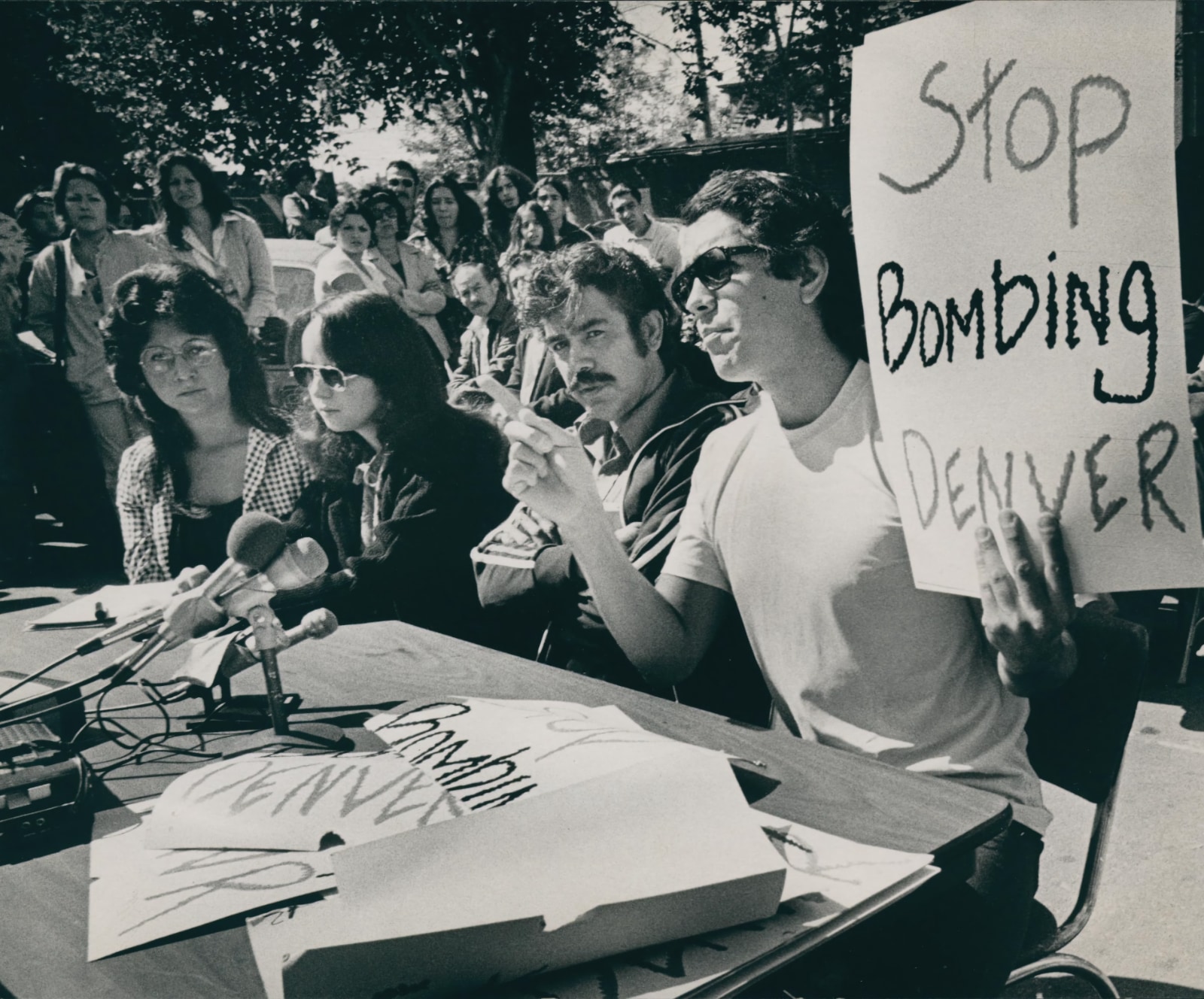
Hundreds of students walk out of their classes at West High School on 20-21 March 1969. They rally outside the school and then march through the neighborhood. Mounted officers and riot squads clash with youth in the streets. They drag students by their hair, kick them in the ribs and beat them with batons.
Demonstrations spread. Hundreds of Chicano students from other Denver schools join. Community members, including parents and local activists, join in solidarity, turning the walkouts into a neighborhood-wide protest.
The West High School Blowouts become one of the most important Chicano youth-led protests in Colorado history. They are followed two weeks later by the First National Chicano Youth Liberation Conference, hosted by the Crusade for Justice. Thousands of young people travel from California, Texas, New Mexico, Colorado, Arizona, and the Midwest. At the conference, the students draft El Plan Espiritual de Aztlan, the movement’s manifesto.
The Westside is on fire. The revolution has begun.
How a Theatre Anchors a Neighborhood
In 2003, a small throng of community activists and Su Teatro supporters protested the takeover of the Denver Civic Theatre at 721 Santa Fe Dr., in Denver’s Westside by Sibling Entertainment, a New York City company. The group intended to “take over” the Denver Civic Theatre’s 501(c)(3) status, paying back the investments of board members attempting to keep the ailing nonprofit afloat. Su Teatro and other nonprofit leaders feared Sibling Entertainment would become a nonprofit in name only, leveraging community assets but not providing community benefits. Protests directed at Sibling Entertainment did not spark revolution, and Su Teatro turned back to its own mission work.
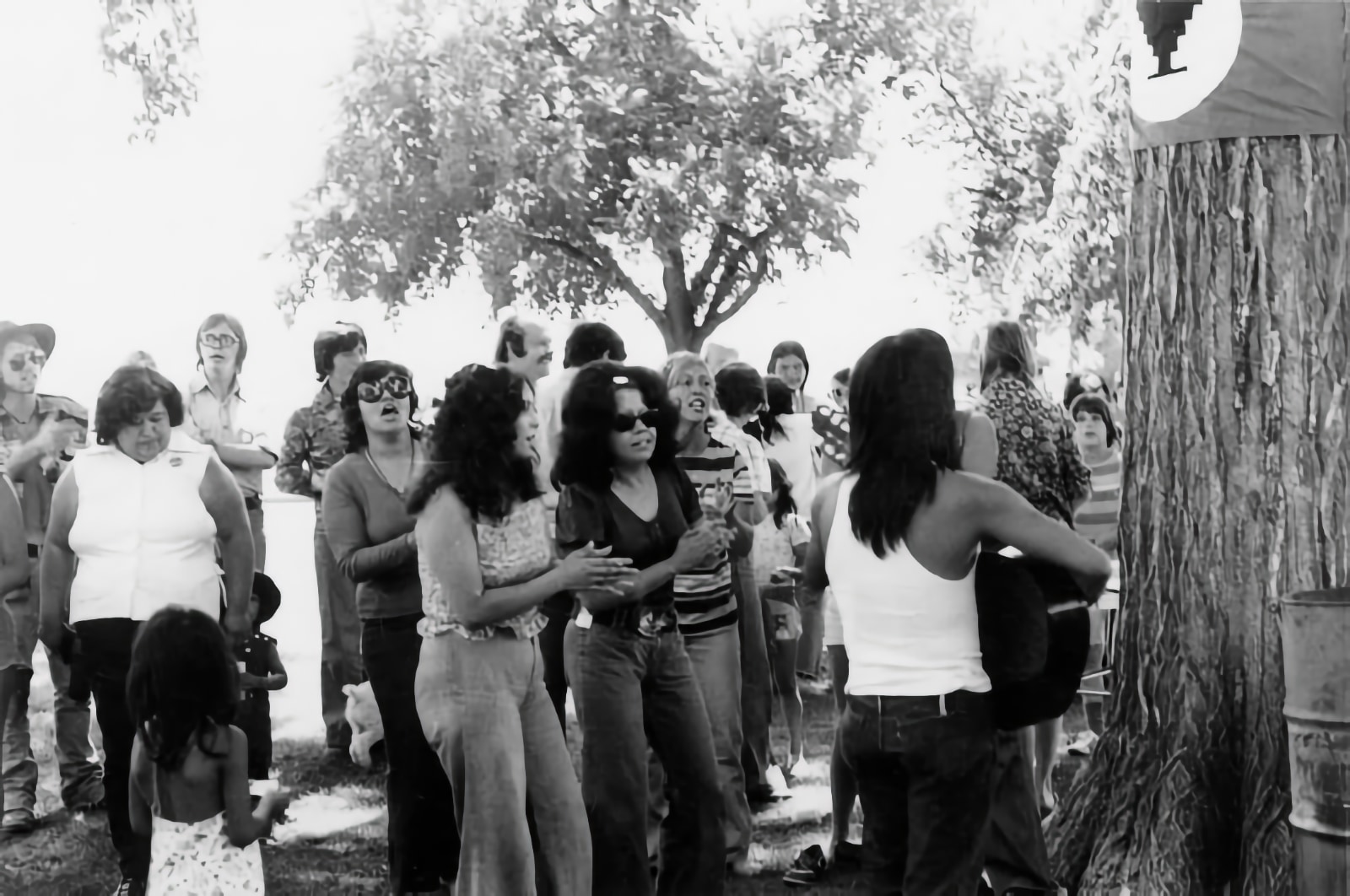
Su Teatro was attempting to move back into the Westside, where it originated in 1972 from a class in Chicano teatro at the University of Colorado Denver. Many company members, including executive artistic director Tony Garcia, grew up in Auraria, and Su Teatro’s community base has deep roots in Auraria, La Alma, and Lincoln Park. One of Su Teatro’s first successful plays was El Corrido del Barrio, a chronicle of the lives of Auraria residents and their displacement.
By 2010, the New Denver Civic Theatre was in foreclosure, and then Mayor John Hickenlooper gave Su Teatro an opportunity to take over the building. Su Teatro viewed the acquisition of the property as an important reclamation of territory in a historic Chicano barrio. Even before Sibling Entertainment took over the Civic, successive theatre companies failed to make the enterprise viable. Critics watched to see how long Su Teatro would last. In 2022, Su Teatro paid off the mortgage on the building, bolstered by an individual donor campaign that raised more than $150,000. In 2024, Su Teatro purchased the nearby “Blue Building” at 659 Santa Fe Dr., this time, with the support of institutional funders. The purchase is especially significant because most of the buildings in the Arts District on Santa Fe, a creative district that cuts through the middle of the Westside, are owned by holding companies. When Tony Garcia was raising money to pay off the mortgage, he told audiences, “Nobody thought we could do it, but it was the Mexicans who stabilized this space.”
The Westside remains, despite the gentry’s renewed interest — despite persistent, systematic marginalization and institutionalized exclusion, first through redlining and slum clearance, then through urban renewal, and now through market-driven reinvestment and gentrification.
Successive generations have loved this place, people who contributed and sacrificed to keep their families alive, to make them safe and to give them opportunities. The Westside is an important place for people who are still fighting against the narratives imposed upon them, structural barriers, and day-to-day challenges. Traditional Westsiders still live here: elders, parents, and children. They have been shaped by relationships sometimes five generations deep. Many of the community institutions they built are still intact and thriving.
They stayed here. Auraria residents who were displaced when the campus was built mostly stayed close by, moving just west or south of Auraria. They were radicalized by the dramatic rupture of their community. They vowed to preserve the cultural heritage of the remaining neighborhood. Denver’s Westside continues to resist erasure, and its people fight for cultural survival.
Both explicitly and implicitly, exclusion, displacement, and the erasure of people, cultures, and histories serve the status quo. Westsiders, who have at least one hundred years of generational experience in protecting this neighborhood, understand the importance of maintaining their territory and the visibility of their presence. Their ongoing vigilance and activism has kept the Westside’s sense of place intact.
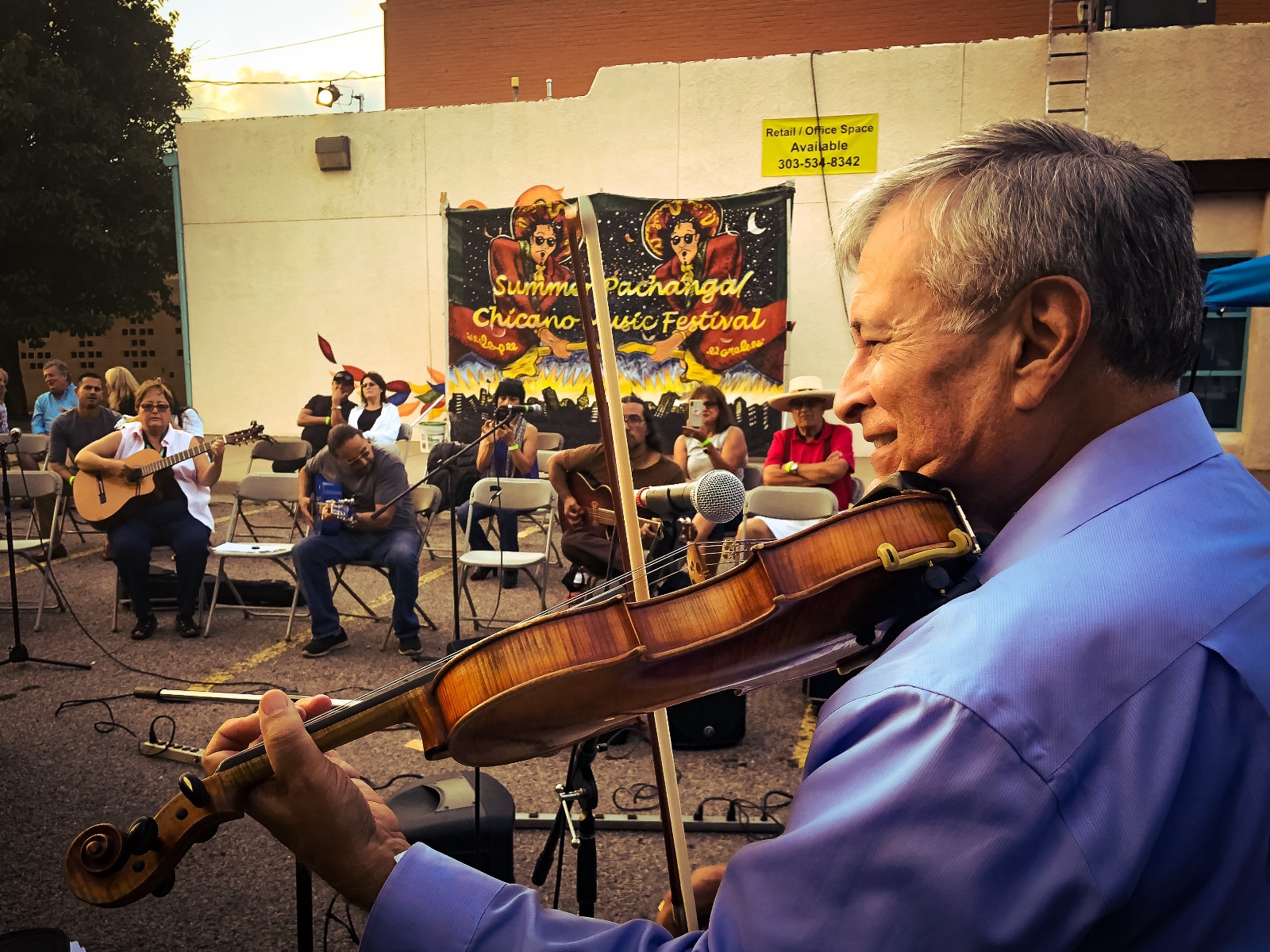
Besides Su Teatro, two other Latinx cultural organizations are based in the Westside, all within blocks of one another. Each has deep roots in the Westside and a loyal community base. Each owns the property where it is housed. Museo de las America founder Jose Aguayo grew up in Auraria, and the Chicano Humanities and Arts Council was founded by Chicano visual artists influenced by the Westside’s cultural renaissance.
Community, Care and Cultural Transmission
Gentrification in the Westside is a microcosm of rising inequality globally. Rising inequality is fueled by an elite minority who understand how to use money to their benefit and who have access to power, influence, and opportunity. With rising inequality inevitably comes revolution. How will we leverage the next revolution? How are we building our enclaves to meet this moment? How we generate and mobilize resources will determine our ability to carve out autonomous spaces and to foster self-determination. Cultivating autonomy positions us to act strategically when the opportunity to exploit contradictions in systems of domination arise.
Those who came before us shared family stories. They protected each other from the effects of marginalization. They attempted to maintain wellbeing despite organized and institutionalized forces designed to fragment, to destroy their fundamental will to survive, and to replicate their culture. Our ability to nurture intentional cultures allows for autonomy, counternarrative, critique, and the perpetuation of lifeways that undermine the notion of white supremacy.
Some revolutions are cataclysmic. They ultimately replicate the systems of domination they seek to eliminate. Others are transformational. They represent a shift in values, norms, and cultural practices that reorganize how societies think, relate, and express identity — sometimes without a single violent rupture. We have practiced for a long time, with mutuality, solidarity, activism, resource generation, and mobilization. As conditions shift and opportunities arise, we need to apply what we have learned. Roses and chilies still grow in the yards here.
Click here to read the other essays in the Why Culture Matters to Justice series.
About Tanya Mote
Tanya Mote is the Associate Director at Su Teatro Cultural and Performing Arts Center in Denver, CO, where she has dedicated 29 years to honing her skills as a resource mobilizer and a movement builder. She has taught in community college and graduate settings for 33 years and has served as a facilitator for the Colorado Creative Industries Change Leader program since 2014. Tanya is an active board member for D3 Arts and In Lak’Ech Arts in Denver, CO; and Narrative Arts in Wilmington, NC. She holds a Ph.D. from the Josef Korbel School of International Studies, where her studies focused on comparative politics, Latin America, and human rights.
Essays
Culture and the Moment
By Sage Crump
What is Cultural Justice?
By Vanessa Whang
Experience As a Whole: Expanding the Boundaries of Cultural Strategy
By Evan Bissell
Building a Reparative Framework for Cultural Equity: Redesigning Creative Business Through Solidarity Economy
By Allen Kwabena Frimpong (nii.a.k)
Chicano Cultural Resistance, a Case Study Across Generations
By Tanya Mote